


AI promised a beautiful future.
What many organisations experienced instead felt underwhelming.
This is not a failure story.
The gap sits between ambition and readiness.
AI is still early relative to what we ultimately expect it to deliver. At the same time, most organisations are not yet structurally prepared to harness its value. Data is fragmented. Processes are brittle. Knowledge lives in people rather than systems.
That mismatch created an expectation gap.
The headlines quietened. The noise dropped. But the anxiety remained. Even teams that feel ahead still feel like they are playing catch-up.
This calm is misleading.
It is not the end of the AI wave. It is the lull before the storm.
Progress is accelerating quietly. Capabilities are compounding. OpenAI, Google, Anthropic and others continue to ship advances that reshape what is possible.
The constraint is no longer innovation.
It is grounding.
The way forward is not to chase tools, but to anchor ourselves in a clearer understanding of how humans and machines work together.
The false divide we keep debating
When uncertainty rises, we default to binaries.
AI conversations often collapse into extremes.
Either AI will replace us, or AI will save us.
Both are wrong.
What we are actually moving toward is a human plus AI operating model, where each side has a defined role.
Humans are not losing value. They are being released from work they were never meant to do at scale.
Machines are not becoming creative geniuses. They are becoming extraordinarily good at what machines have always been good at: computation, optimisation, memory, and pattern recognition.
This split is not new. It is evolutionary.
We moved from pen and paper to spreadsheets. From spreadsheets to computing. From computing to AI.
Each step reduced the friction of calculation. None removed the need for human judgment.
AI is simply the next step.
What humans should keep
Humans shine where context, intent, and people matter.
Imagination. Judgment. Negotiation. Vision. Stakeholder alignment. Narrative.
These are not inefficiencies to be automated away. They are the point.
What machines should take on
Scale. Computation. Pattern detection. Forecasting. Simulation. Optimisation.
These tasks constrain humans not because they are unimportant, but because they consume time and cognitive bandwidth.
Delegating them does not reduce human value. It amplifies it.
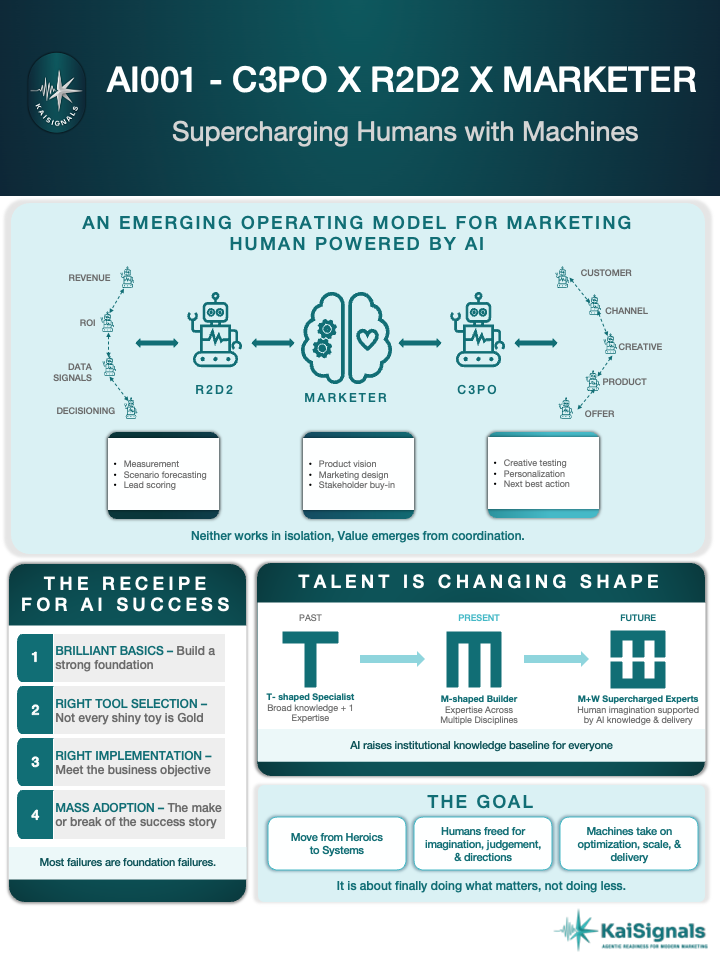
C3PO x R2D2 x the marketer
Marketing has always lived at the intersection of art and science, what psychology would call System 1 and System 2 thinking.
What AI has done is not invent something new, but expose that split more clearly.
One side of marketing is about context and meaning: understanding the customer, the channel, the creative, the product, and the offer. Holding memory, nuance, and situational awareness so the right message appears at the right moment.
That is C3PO.
The other side is about maths and optimisation: revenue logic, forecasting, marginal ROI, financial trade-offs, and decisioning at scale.
That is R2D2.
Neither works in isolation.
Sitting above both is the marketer.
The role that sets intent, defines direction, and exercises judgment over what should be optimised and why.
This is not science fiction. It is a clearer way of naming what marketing has always been.
I first shared this framework earlier this year as a way to describe where marketing was heading. Six months on, I now see versions of it emerging across teams and organisations.
This model becomes the anchor for everything that follows in this series.
Reward functions. Architecture. Memory. Time awareness.
We will keep returning to C3PO and R2D2 to make each of those ideas tangible.

The misconceptions we need to kill
The first misconception is that AI is coming.
It is here.
The second is that adoption is optional.
It is not. The cost of not adopting compounds quietly until it becomes visible.
The third is the most dangerous: buying a tool makes you AI-enabled.
It does not.
AI success follows a simple but unforgiving sequence.
Foundations. Right tool selection. Implementation. Adoption.
If any one of these fails, the system fails.
Most AI failures are not intelligence failures. They are foundation failures.
When AI hallucinates, it is usually because we forced it to imagine instead of compute.
Talent is changing shape
For years, we talked about T-shaped individuals: broad knowledge with one deep spike.
That model no longer holds.
Modern roles require multiple spikes.
Strategy. Data. Experimentation. Creative reasoning. Commercial thinking.
This is the M-shaped reality many leaders already live.
AI changes what comes next.
AI becomes the W layer.
It raises the baseline institutional knowledge for everyone.
Like groundwater rising, it allows teams to draw insight from many places without having to dig alone.
This also changes how knowledge accumulates.
Humans bring top-down intent and expertise, like stalactites forming from above.
AI builds bottom-up intelligence, like stalagmites growing from signals and patterns.
Over time, they meet.
That is how organisations move from heroics to systems.
What this means for teams and leaders
AI-ready organisations do not start with tools.
They start with documentation. Structured data. Clear processes. A culture of experimentation.
Leaders play a critical role.
They must create space for learning. Provide access to tools. Set goals that reward real adoption, not vanity usage.
Not all change is welcomed, and some discomfort is inevitable.
But this shift does not hollow out roles. It deepens them.
By removing grunt work, AI forces us to become better at thinking, not worse. It creates space to shift away from constant System 1 reactions and spend more time in System 2 thinking: deliberate judgment, structured reasoning, and higher-quality decision-making.
More time for whiteboarding. More time for debate. More time for synthesis.
Collaboration improves because the baseline knowledge rises and cognitive bandwidth is freed.
The conditions for better ideas improve.
Looking ahead
There is a future where agents become more autonomous and systems more intelligent.
AI-2027 is not my work, but it is a useful thought exercise for where this could go.
We are not there yet.
Today is about preparation.
The rest of this series moves from why this matters to how it works.
Reward functions. Architecture traps. Memory. Time awareness. Orchestration.
Each builds on the same foundation.
A return to marketing
When machines learn to think, marketers return to marketing.
Not the mechanics.
The meaning.
This is not about doing less. It is about finally doing what matters.
As AI takes on optimisation, calculation, and scale, humans are freed to focus on imagination, judgment, and direction. The parts of the work that shape outcomes rather than just execute them.
If this shift is underway, the real question is not whether AI will change your role.
It is which parts of your work you choose to keep, and which you are ready to let go.
The rest of this series exists to help make that choice deliberate.
That is where the next posts begin.