


AI does not misunderstand strategy.
It ignores it.
Not because AI is flawed, but because strategy is written for humans.
Judgement, context, intent, trade-offs.
None of that is executable.
AI follows reward functions.
Whatever you encode as success is what it will optimise, scale, and defend.
If the outcome surprises you, the problem is rarely the AI.
It is almost always the reward.
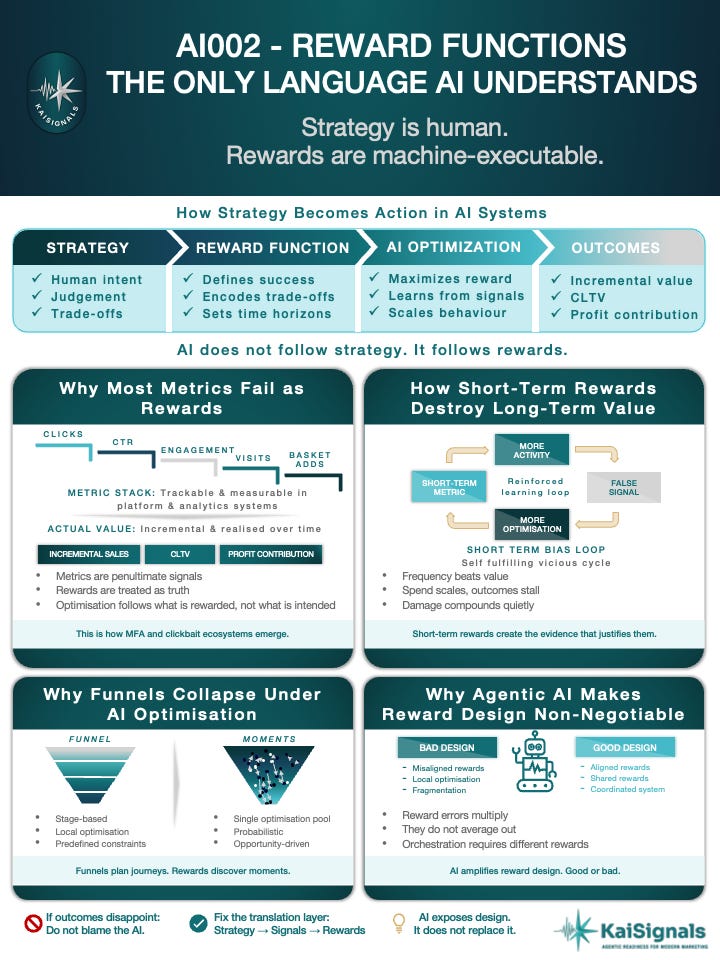
How Strategy Becomes Action in AI Systems
There is a clean translation layer that most organisations skip.
Strategy → Reward Function → AI Optimisation → Outcomes
Strategy expresses intent.
Reward functions define success.
AI optimisation maximises that success.
Outcomes are simply the byproduct.
AI does not follow strategy.
It follows rewards.
If you leave the translation vague, AI does not pause.
It fills the gaps with assumptions and scales them fast.
Why Most Metrics Fail as Rewards
Most marketing metrics were never designed to be rewards.
Clicks.
CTR.
Engagement.
Visits.
Basket adds.
They are penultimate signals, not outcomes.
They are trackable, fast, and measurable, which makes them convenient.
But convenience is not correctness.
When these metrics are treated as rewards, AI optimises them as truth.
It cannot tell the difference between activity and value because you told it they were the same.
This is how MFA sites and clickbait ecosystems emerged.
The systems were not broken.
They were performing exceptionally well against a bad reward.
Optimisation always follows what is rewarded, not what is intended.
How Short-Term Rewards Destroy Long-Term Value
Short-term rewards create a self-fulfilling system.
Reward short-term activity and the system learns to manufacture it.
More clicks.
More engagement.
More apparent performance.
But the signal is false.
The learning loop reinforces itself:
Short-term metric
More optimisation
More activity
Stronger belief the metric matters
Spend scales.
Outcomes stall.
This is not a failure of execution.
It is a failure of reward design.
Short-term rewards create the evidence that justifies them, even as real value erodes.

Why Funnels Collapse Under AI Optimisation
Funnels are a planning abstraction.
AI operates probabilistically.
When optimisation is split into funnel stages, AI is forced into local optimisation:
Stage-based targets
Artificial constraints
Fragmented learning
The system cannot see the full opportunity space.
When rewards are applied across the full journey, funnels stop mattering.
AI discovers moments, not stages.
Funnels plan journeys.
Rewards discover opportunities.
Funnels do not fail because AI is weak.
They fail because the optimisation space is too small.
Why Agentic AI Makes Reward Design Non-Negotiable
AI amplifies reward design. Good or bad.
Earlier systems were constrained by compute, data, and manual controls.
Those constraints masked poor reward design.
Agentic AI removes the safety net:
Faster decisions
More autonomy
Continuous optimisation
Fewer human checkpoints
Reward errors do not average out.
They multiply.
In multi-agent systems, local optimisation compounds.
An acceptable 80% decision at one layer becomes 60%, then 50%, then worse as it cascades.
No agent is failing.
Every agent is succeeding locally.
The system fails because the rewards do not ladder up.
Orchestration requires different rewards, not better agents.
Signals Beat Instructions
Instructions constrain behaviour.
Signals inform decisions.
Over-instruction creates information asymmetry.
Under-signalling forces AI to optimise blindly.
The best systems:
Maximise signal quality
Maximise signal frequency
Protect signal stability
Broken signals teach AI that events are not happening, not that tracking is broken.
Signals are infrastructure, not plumbing.
Exploration Is Not Penalised by Default
Exploration fails when it is judged using exploitation rewards.
If exploration is the strategy, the reward must encode:
Risk tolerance
Delayed feedback
Learning over efficiency
Using the same reward for exploration and exploitation guarantees failure.
AI is not biased toward short-termism.
It is biased toward whatever you told it success looks like.
This Is a Solvable Challenge
Change starts at the top
AI does not perform badly under bad rewards.
It performs perfectly.
Bad rewards get amplified.
Good rewards get amplified the same way.
When outcomes disappoint, blaming AI feels convenient, but it stops learning. The system is doing exactly what it was designed to do. The failure, when it exists, sits in the translation layer between strategy and execution.
Leadership in an AI-enabled organisation means owning that translation.
It means turning intent into signals.
Turning strategy into rewards.
And accepting that machines will execute literally what they are taught to optimise.
AI does not replace leadership judgment.
It exposes it.
The Fix: Repair the Translation Layer
Most organisations do not need more models.
They need better translation.
Strategy must be deliberately converted into:
Clear signals
Explicit trade-offs
Well-designed reward functions
AI exposes design quality.
It does not replace it.
If outcomes disappoint:
Do not blame the AI
Fix the translation layer
Align strategy → signals → rewards
Final Thought
AI does not follow strategy.
It follows reward functions.
Whatever you choose to reward is what you will get more of.
At scale.
At speed.
Without apology.
Choose carefully.