


Funnels feel broken.
Performance is volatile. Campaigns that worked last quarter stall. New formats appear to violate basic marketing logic by delivering short-term sales where none should exist.
The usual diagnosis is that consumer behaviour has become non-linear or chaotic.
That diagnosis is wrong.
Funnels are breaking because AI learns probabilistically, while most organisations still execute sequentially. The tension is not between art and science. It is between human control systems and machine learning systems.
This is not a call to abandon fundamentals. Funnel intent remains sound. What has failed is how funnels are operationalized in an AI-led world.
Why funnels still make sense in theory
Funnels were designed to impose order on low-signal environments. In a world of manual optimisation, limited data, and slow feedback loops, breaking demand into stages helped teams prioritise spend, messaging, and accountability.
They also created narrative clarity. Linear journeys are easy to explain, plan, and report against. Senior stakeholders could see progress even when causality was imperfect.
The problem starts when a planning abstraction becomes an execution constraint.
When stage definitions dictate how systems must operate, they slow learning instead of enabling it.
The intent of the funnel remains valid. The execution model does not.
Where funnel execution actually breaks
Most organisations execute funnels by splitting responsibility.
Internal teams own stages
Agencies own channels
Budgets are allocated independently
Each unit optimises its slice of the journey against local KPIs.
This structure is not a competence failure. It is an organizational outcome.
Under execution pressure, collaboration becomes expensive. Teams optimise locally because they are measured locally.
Signals fragment before AI even enters the picture.
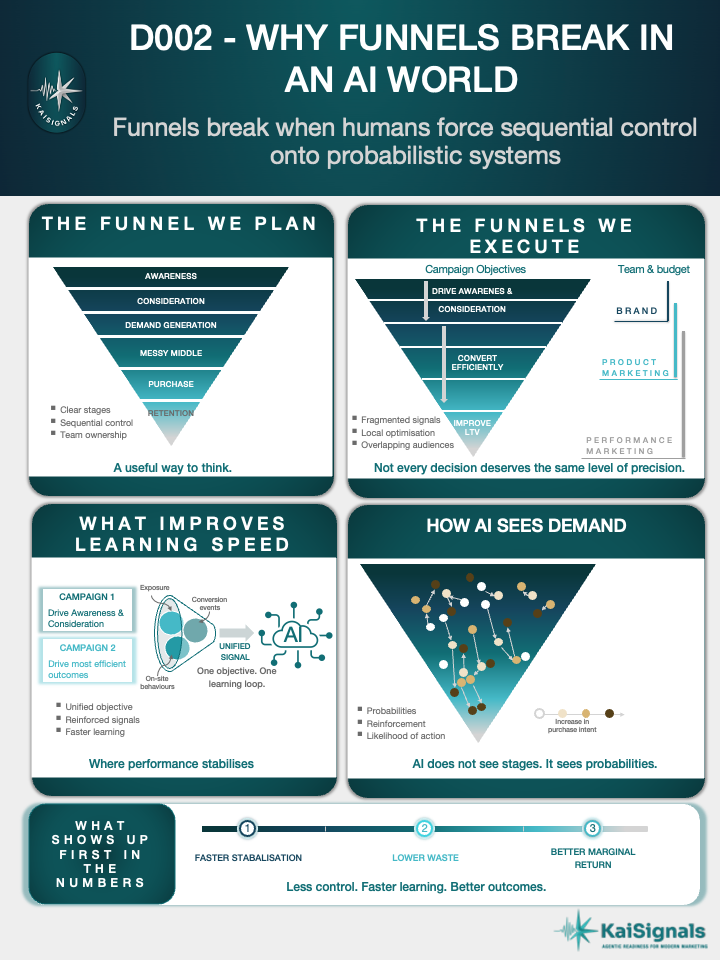
AI does not see stages. It sees probabilities
AI systems do not understand awareness, consideration, or conversion as discrete states. They aggregate behavioural, contextual, and response signals into likelihoods.
Probability of intent is the optimisation input. Labels are not.
Consumers do not move cleanly through stages. Their readiness to act fluctuates. AI adjusts continuously.
When marketers force AI into pre-defined funnel buckets, learning slows, signal density drops, and reinforcement breaks.
The system is asked to reconcile partial objectives instead of optimising toward a unified outcome.
When AI appears to break funnel logic but is actually right
This tension becomes visible when so-called upper-funnel campaigns deliver short-term sales.
Reach or Demand Gen inventory is priced assuming low conversion probability. Platform optimisation already accounts for the fact that a small subset of uninitiated consumers will convert.
When messaging aligns, offers are appropriate, targeting is broad enough, and learning budgets are sufficient, AI surfaces these pockets faster than funnel logic expects.
Attribution obscures this effect. Incremental measurement reveals it.
The confusion is not caused by AI behaviour. It is caused by funnel expectations.
Signal continuity versus channel and team silos
Funnels fragment signals in two ways.
Organizationally, different teams and agencies operate with partial information and individual budget ownership. Each optimises locally.
Algorithmically, stage-based campaigns emit incomplete signals about the same consumer. Upper-, mid-, and lower-funnel campaigns target overlapping audiences probabilistically but are treated as distinct states.
Sequencing breaks. Messaging becomes inconsistent. Learning fragments.
On-site behaviour remains the most reliable source of intent:
Basket adds
Progression through purchase steps
Conversion events
When these signals are unified and passed back to platforms through server-side integrations, AI can probabilistically connect exposure to intent.
Funnel-led execution prevents this reinforcement.
Why funnel reporting misleads commercial decisions
Stage-based reporting explains activity, not value.
It masks marginal returns, hides saturation until performance collapses, and corrupts incrementality tests through overlapping exposure.
Performance appears stable until headroom is exhausted. Then it falls abruptly.
This is not a media problem.
It is a reporting problem.
Where growth curves reframe the question
Growth curves reveal what funnel ROI cannot: the relationship between spend and incremental return.
In AI-optimised systems, marginal returns matter more than stage efficiency. The next pound matters more than the last attribution credit.
Marketing mix models act as an audit layer above AI. They validate whether allocation aligns with commercial reality without constraining learning.
Commercial truth sits above tactical optimisation.
Attribution in an AI world
Last-click attribution collapses multi-moment influence into a single touch. It destroys the signal structure AI relies on.
Conversion lift studies help. They introduce counterfactuals and reduce platform bias.
Used poorly, they mislead. Used well, they validate.
Incrementality should build confidence, not control systems.
What replaces the funnel in practice
The replacement is simpler than it sounds.
Fewer campaigns
Unified objectives
Broader eligibility
Consistent strategy across platforms
Creative diversification becomes the primary way to speak to different moments of intent.
Structure simplifies. Messaging diversifies. AI allocates.
This is where AI scales without sacrificing efficiency.
A different definition of good marketing
The first assumption to challenge is that more control equals better performance.
The earliest signal of progress is faster stabilization after launch.
The strongest confirmation follows later through improved marginal returns at the same level of spend.
Control is not safety. In AI-led environments, it is often constraint.
Release control to AI. Validate commercially. Trust but test.
That is what good marketing looks like now.