


OPENING
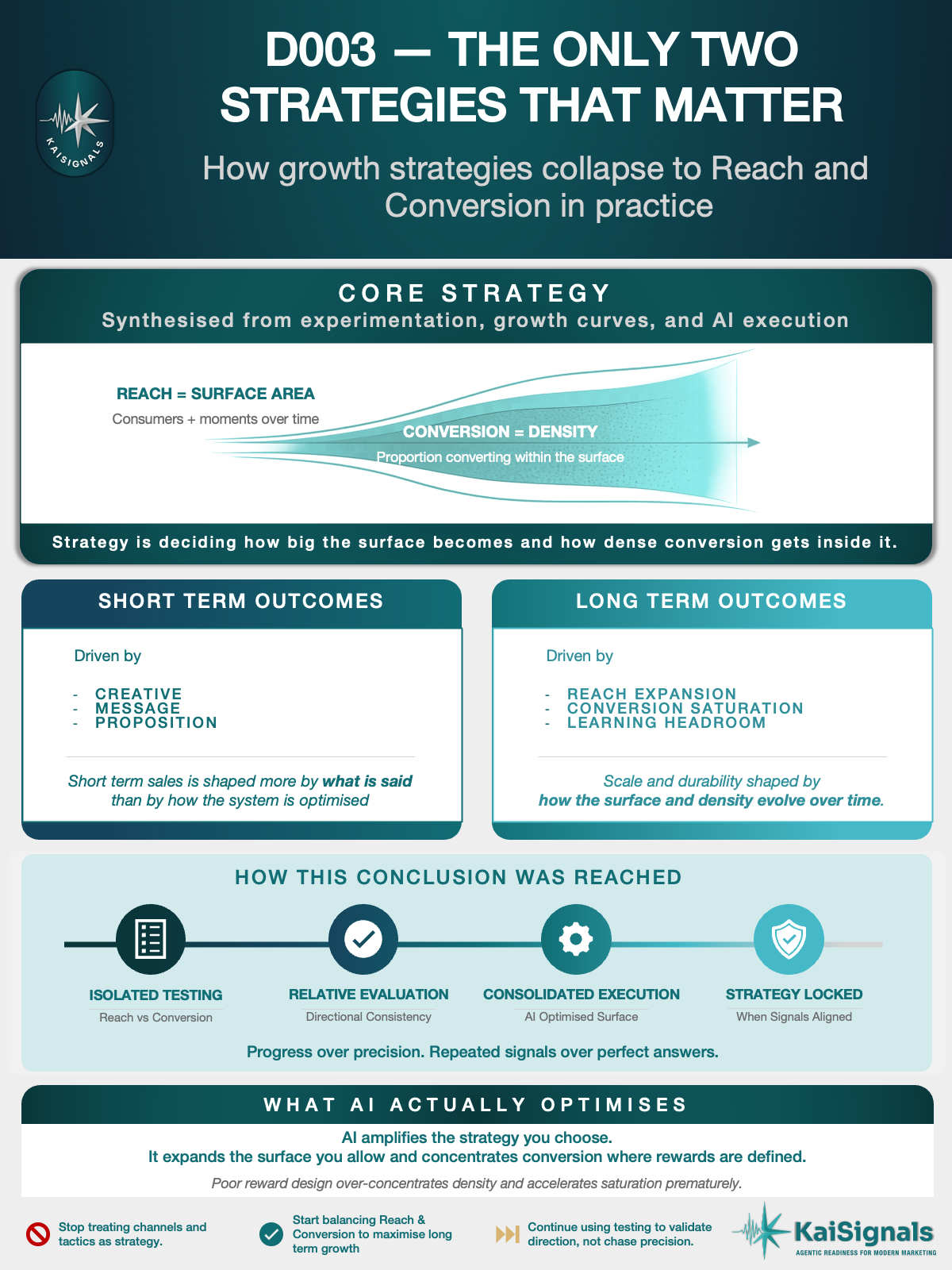
Most marketing strategies sound different. In practice, they resolve to the same two levers.
How much surface area you create. How much of that surface converts.
Everything else is an expression of one or both.
This is not a law of physics. It is a practical operating abstraction. Useful even when imperfect. Especially in an AI-led system where complexity compounds faster than humans can manage it.
If funnels feel broken, and optimisation feels busy but brittle, this is why.
(For the foundations behind this shift, see D001 and D002. For how we learned this empirically, see M007.)
1. A UNIVERSAL OPERATING ABSTRACTION
Strategy is often taught as a choice between channels, formats, or tactics.
In reality, growth decisions answer two questions:
How many people and moments can encounter us?
What proportion of those encounters convert?
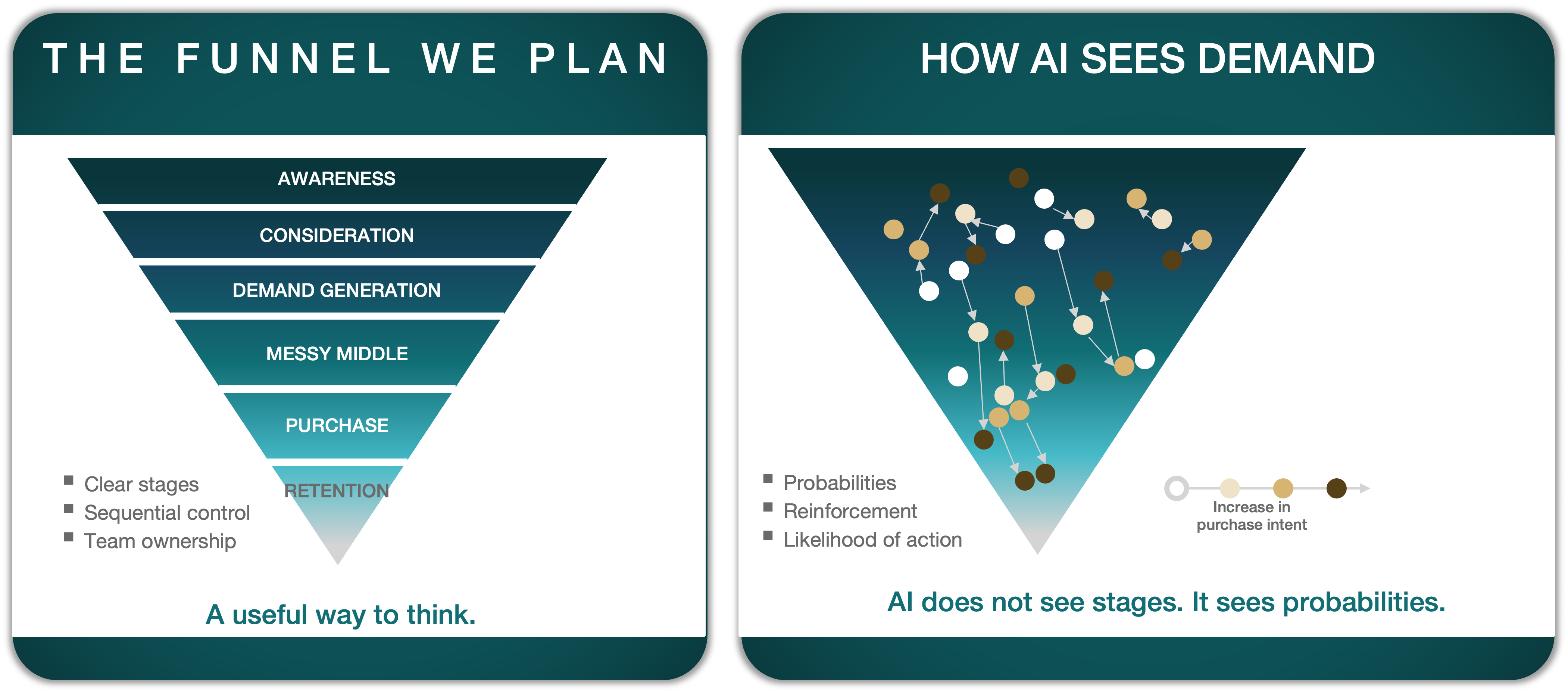
This abstraction matters because AI does not reason in channels or stages. It reasons in opportunity size and response probability. If you cannot articulate strategy at this level, the system will do it for you, implicitly and often poorly.
2. REACH AS SURFACE AREA (PEOPLE AND MOMENTS)
Reach is not awareness.
Reach is surface area across people and time. The total set of moments in which your brand can plausibly show up.
This is where optionality lives.
When reach is constrained, learning collapses before revenue does. Early efficiency often looks like success when it is simply the byproduct of a starved system.
Exploration expands surface area. That does not make it wasteful. It is how the system learns where growth is allowed to come from.
This is why experimentation is not about proving winners. It is about mapping space.
3. CONVERSION AS DENSITY (INTRODUCING PRESSURE CAREFULLY)
Conversion is not performance marketing.
Conversion is density. The proportion of the reachable surface that turns into action.
This density is shaped by intent signals, sequencing, creative, and spend. Some teams refer to this as pressure. If that term feels heavy, think of it simply as conversion density.
In practice, both reach-led and conversion-led approaches can deliver short-term sales when the creative and proposition are right, often price-led. The distinction between short-term and long-term impact showed up less in optimisation mechanics and more in how quickly conversion density saturated over time.
Two properties matter:
Returns are non-linear.
Saturation arrives faster than expected.
Short-term efficiency can look like intelligence. Over time, it often reveals fragility.
4. WHY EVERYTHING ELSE IS A DERIVATIVE
Most familiar constructs fall out naturally once reach and conversion are explicit.
Channels are different reach surfaces.
Creative modulates conversion density.
Targeting concentrates density within subsets of reach.
Frequency increases density over time.
These are not strategies. They are expressions.
The mistake is promoting expressions to strategy, then wondering why systems drift or stall.
5. EXPLORATION VS EXPLOITATION (A LIVING MODEL)
Exploration maps primarily to reach. Exploitation maps primarily to conversion.
The mapping is not pure. Exploration can generate short-term outcomes, but its primary role is to expand the space the system understands.
Without deliberate exploration, optimisation converges on local maxima. Efficient, repeatable, and ultimately capped.
This is not theory. It is an operating reality.

6. PERFORM VS TRANSFORM (THE ENGINE)
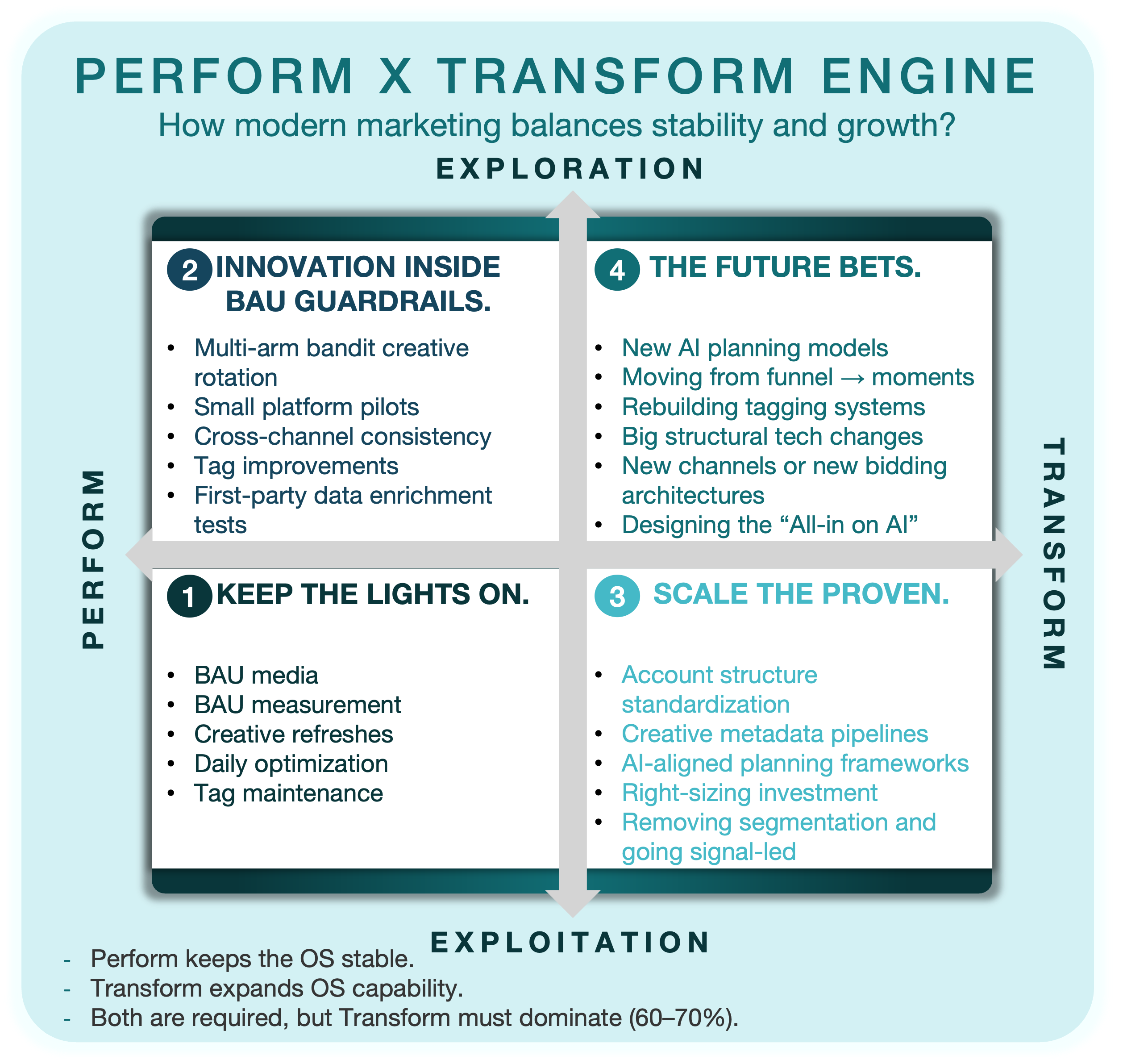
Perform stabilises outcomes inside known space. Transform changes the shape of the space itself.
Transformation does not sit only in long-term brand bets. It often happens inside exploited territory:
Introducing server-side tracking.
Shifting to new formats.
Simplifying campaign structures.
Moving planning logic to be AI-aligned.
These actions can deliver short-term gains while fundamentally altering what the system can do next.
Perform keeps the system running. Transform expands what the system is capable of.
Both are required. Over time, transformation must dominate.
7. WHAT AI ACTUALLY OPTIMISES
AI optimises what we ask it to optimise.
Ask for reach and it finds net new exposure. Ask for conversion and it concentrates intent.
Everything else is a subset of these instructions.
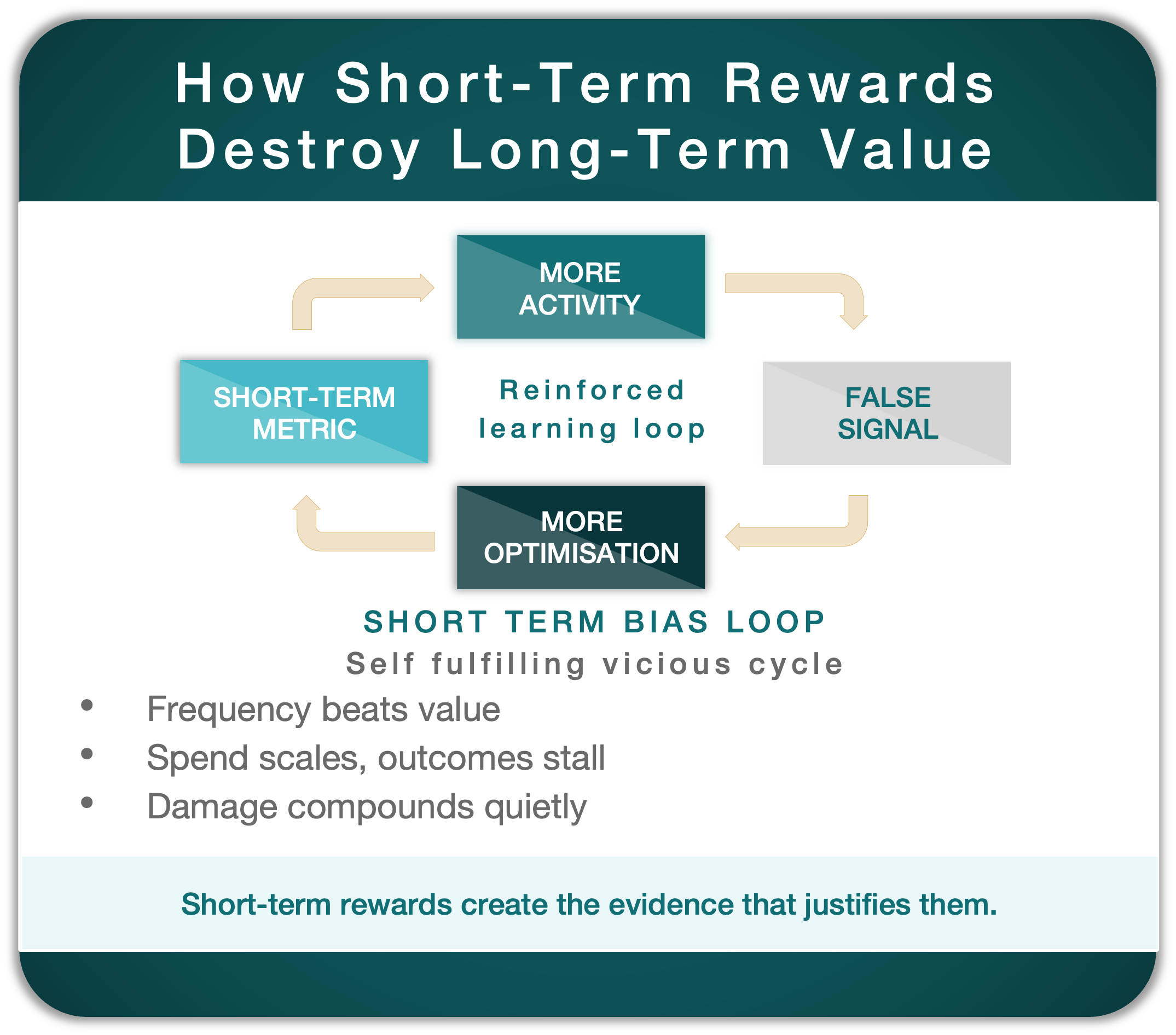
This is where reward design matters. Poorly designed rewards push the system to over-concentrate conversion density. Short-term gains follow. Long-term decay is inevitable.
This is not an AI problem. It is a strategy problem.
8. PRACTICAL OBSERVATIONS FROM THE FIELD
In practice, the pattern is consistent:
Constraining retargeting often improves learning.
Simplifying structures produces both directional and precise efficiency gains.
Growth curves expose when conversion density is saturated and reach must expand.
These are not best practices. They are recurring signals when systems are allowed to learn properly.
CLOSING
Strategy is not channel choice.
It is deciding how much surface area you are willing to explore, and how much conversion density you are willing to apply.
AI does not change this. It enforces it.
If you are trying to translate these mental models into operating systems that run day to day, this is the problem KaiSignals works on.