


Most organisations say they want to be data-driven.
Very few actually are.
Not because they lack data, models, or dashboards - but because they misunderstand what measurement is for.
Measurement is not about certainty.
It is about making decisions under uncertainty.
That distinction matters more than most teams realise.
The Measurement Chain We Rarely Design
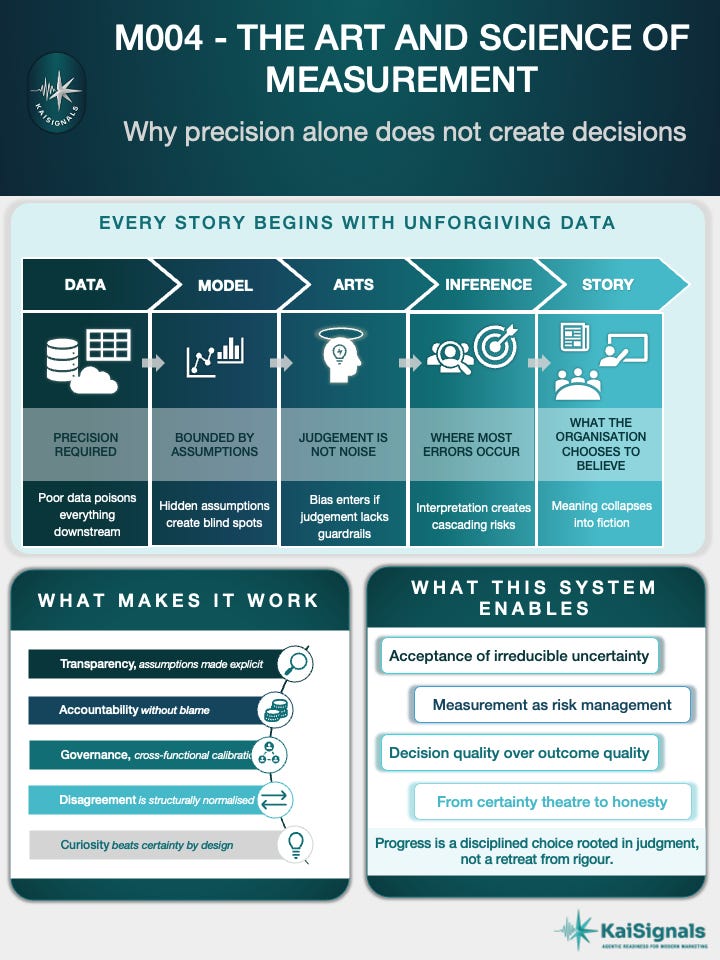
Every decision-shaping story follows the same path, whether we acknowledge it or not:
Data → Model → Arts → Inference → Story
This is not a workflow.
It is how organisations turn reality into belief.
Break any link, and what follows may sound confident - but rest on fiction.

Data: Precision Is Non-Negotiable
Data is unforgiving.
Observations, signals, and logs do not care about strategy, intent, or ambition. Poor data poisons everything downstream.
There is no compensating for weak data later in the process. Precision here is table stakes.
Models: Powerful, Bounded, and Often Misused
Models impose structure on data. Statistics, regressions, causal methods - the machinery of science.
They are precise. They are persuasive. And they are always incomplete.
Every model is bounded by assumptions. When those assumptions remain implicit, blind spots form. Overconfidence follows.
Treat models as decision engines rather than decision inputs, and everything that should come after them disappears.
Arts: Judgment Is Not Noise
This is where many organisations get uncomfortable.
The Arts layer is not intuition or gut feel.
It is not permission to ignore science.
It is where domain context, lived experience, commercial judgment, and risk appetite mediate what the science is actually saying.
Judgment is not noise.
It is a control system.
Without judgment, models are brittle.
Without discipline, judgment becomes bias.
The answer is guardrails - not removal.
Inference: Where Errors Quietly Compound
Inference is interpretation under constraint.
It is where outputs become meaning and implications. It is also where most errors occur.
Numbers are easy to debate.
Meaning forces commitment.
When interpretation is rushed or poorly owned, small misunderstandings cascade into large strategic mistakes.
Story: What the Organisation Chooses to Believe
Story is not spin.
It is commitment.
Narratives frame decisions, align teams, and move money. They define what the organisation chooses to believe - and act on.
When earlier stages are weak, stories sound compelling but rest on fragile ground.
When the chain holds, stories become vehicles for disciplined action.

Why Precision Alone Fails
Early in my career, credibility meant completeness. Precision was the north star.
That belief had to be unlearned.
Completeness is not credibility.
Simplification is not dilution.
Decision forums reward clarity over exhaustiveness. The question shifts from “Is this correct?” to “What do we do next?”
Precision enables insight.
Judgment enables action.
What Makes This System Work
The data-to-story chain only works when culture reinforces it:
Transparency: assumptions made explicit
Accountability without blame: outcomes owned, learning amplified
Governance: cross-functional calibration before decisions
Normalised disagreement: treated as signal, not failure
Curiosity by design: questioning beats false certainty
These are not soft principles.
They are structural requirements.
The Real Point
Measurement is a complete journey.
Precision matters at the start.
Judgment matters in the middle.
Story matters at the end.
Over-index on any one, and the system breaks.
Get the chain right, and measurement finally does what it was always meant to do:
Help humans decide
Where this series goes next
If M001 established that perfect measurement is impossible, and M002–M003 explored why organisations still chase precision and fall into familiar traps, M004 is the hinge. It reconciles analytical rigour with human judgment and explains why measurement only works when science and interpretation are designed together.
The next article, M005 – Money In, Money Out: The Only KPI That Matters, builds directly on this foundation.
M005 will shift the focus from how decisions are interpreted to how they are economically anchored. It will explain marginal economics, diminishing returns, and why optimisation cannot be judged through media metrics alone. Using growth-curve work from Meta and real-world budget allocation examples, it will show how spend is actually optimised in practice, not in dashboards.
Where M004 argues that judgment is a control system, M005 makes that control explicit: commercial outcomes are the final arbiter. All models, stories, and interpretations ultimately collapse into a single question: are we putting money in places where incremental returns justify the risk?
Together, M001–M005 form a progression:
M001 reframed measurement as progress, not truth
M002 showed why precision is often overvalued
M003 exposed the fallacies that make organisations fear measurement
M004 explained how science becomes action through judgment and story
M005 grounds everything in marginal value and money flow


This is where measurement stops being theoretical and starts being unavoidable.