


The question we keep avoiding
Marketing teams debate channels, formats, platforms, creatives, and tactics.
But every one of those debates hides the same unspoken question:
Where should the next pound go?
Most organisations never answer that question directly. They answer it through CPA, ROAS, lift scores, dashboards, and benchmarks. Those metrics feel concrete and precise.
They are also why budgets stay in the wrong places for far too long.
Marketing decisions are not optimisation problems. They are capital allocation decisions.
Marketing is not a channel problem. It is an investment problem.
Marketing does not compete with other channels.
It competes with every other use of capital.
Product investment. Pricing changes. Distribution. Retention. Customer experience. Even doing nothing.
If marketing cannot be evaluated on the same scale as those alternatives, it will always be misallocated. Not because teams are incompetent, but because the decision logic is incomplete.
This is why profit and contribution margin matter more than any media metric. Metrics are local. Capital is global.
Why media metrics create false confidence
CPA, ROAS, platform scores, and attribution outputs are not wrong.
They are incomplete.
They describe local efficiency, not opportunity cost.
A channel can look efficient and still be the wrong place for the next pound. A campaign can hit every target and still crowd out a better use of capital elsewhere.
This is the failure mode most teams never see:
They optimise what they can measure and stop comparing what actually matters.
Efficiency inside a channel tells you nothing about whether money should be there at all.
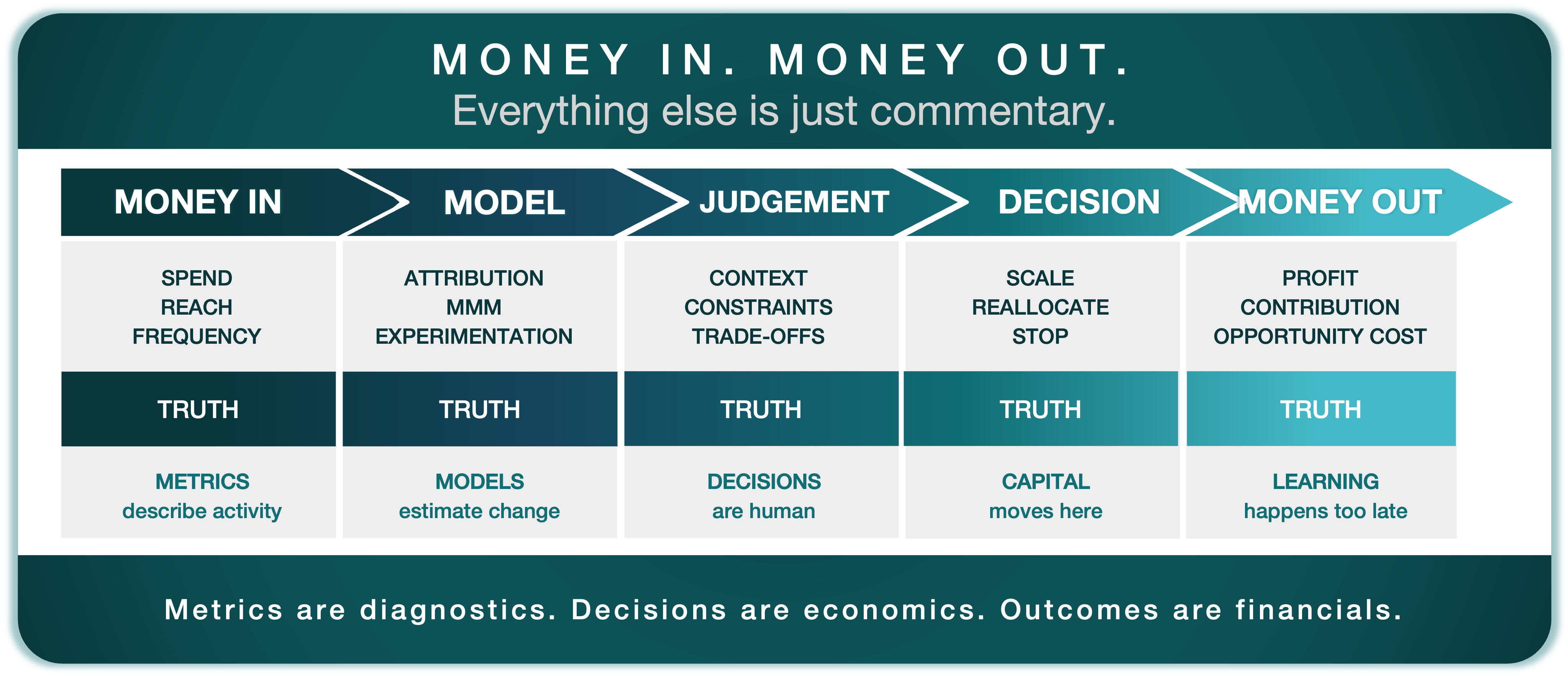
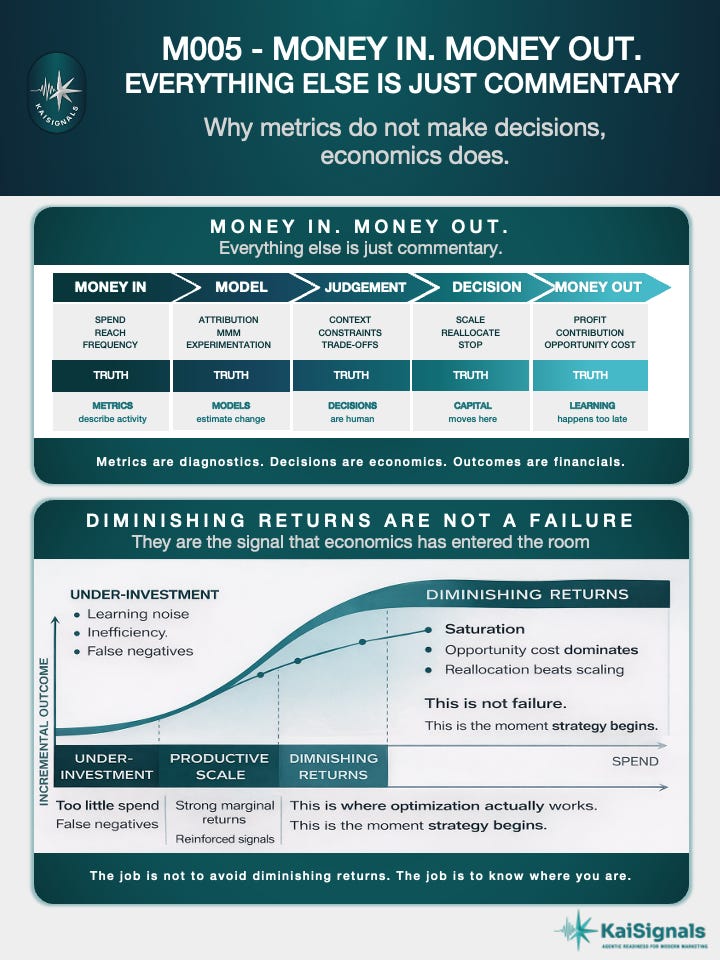
Money in. Money out.
Strip away the jargon and the problem becomes simple:
What changes in outcome when spend changes?
That is marginal return expressed in plain language.
Money in. Money out.
This is not about perfect precision. It is about relative comparison. You do not need the exact answer. You need to know whether one use of capital is better than another.
Most organisations already have enough data to start doing this. What they lack is the translation layer that turns metrics into economic decisions.
Diminishing returns are not a failure
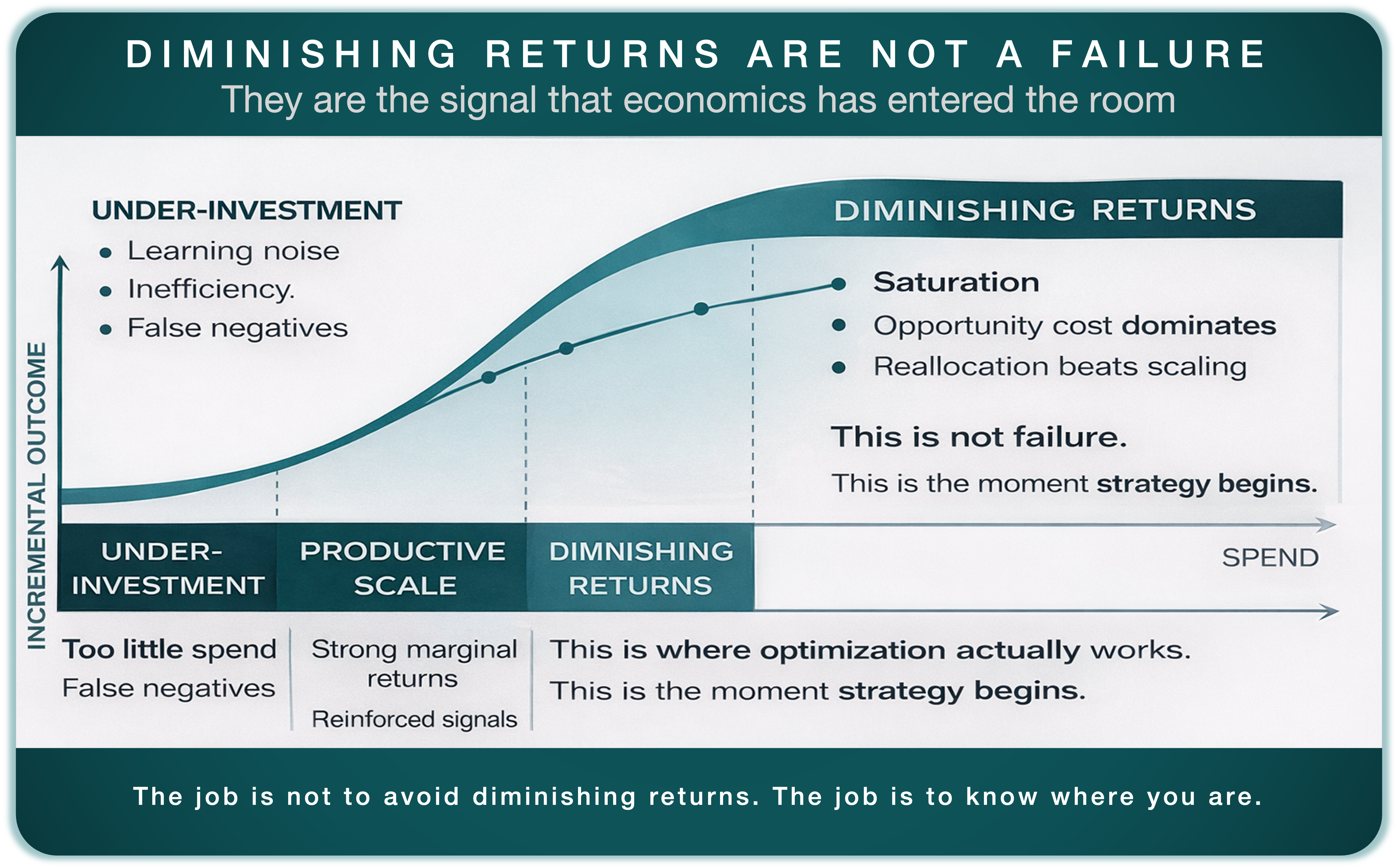
Spend too little and you are inefficient.
Spend too much and you waste capital.
Diminishing returns are inevitable. They are the signal that economics has entered the room.
The real failure is not hitting diminishing returns.
The real failure is not knowing where you are on the curve, and not testing where the curve bends.
Under-investment hides signal and creates false negatives. Teams conclude something does not work simply because it never had room to show up.
Over-investment crowds out better opportunities and turns efficiency into complacency.
Why channel-level optimisation breaks budgets
Channels are optimised independently.
Budgets are not.
Teams scale what looks efficient instead of reallocating to what is most valuable. Over time, money pools in familiar places, not optimal ones.
Reallocation beats scaling.
Not because scaling is wrong, but because opportunity cost compounds quietly while everyone is busy hitting targets.
The misalignment most teams miss
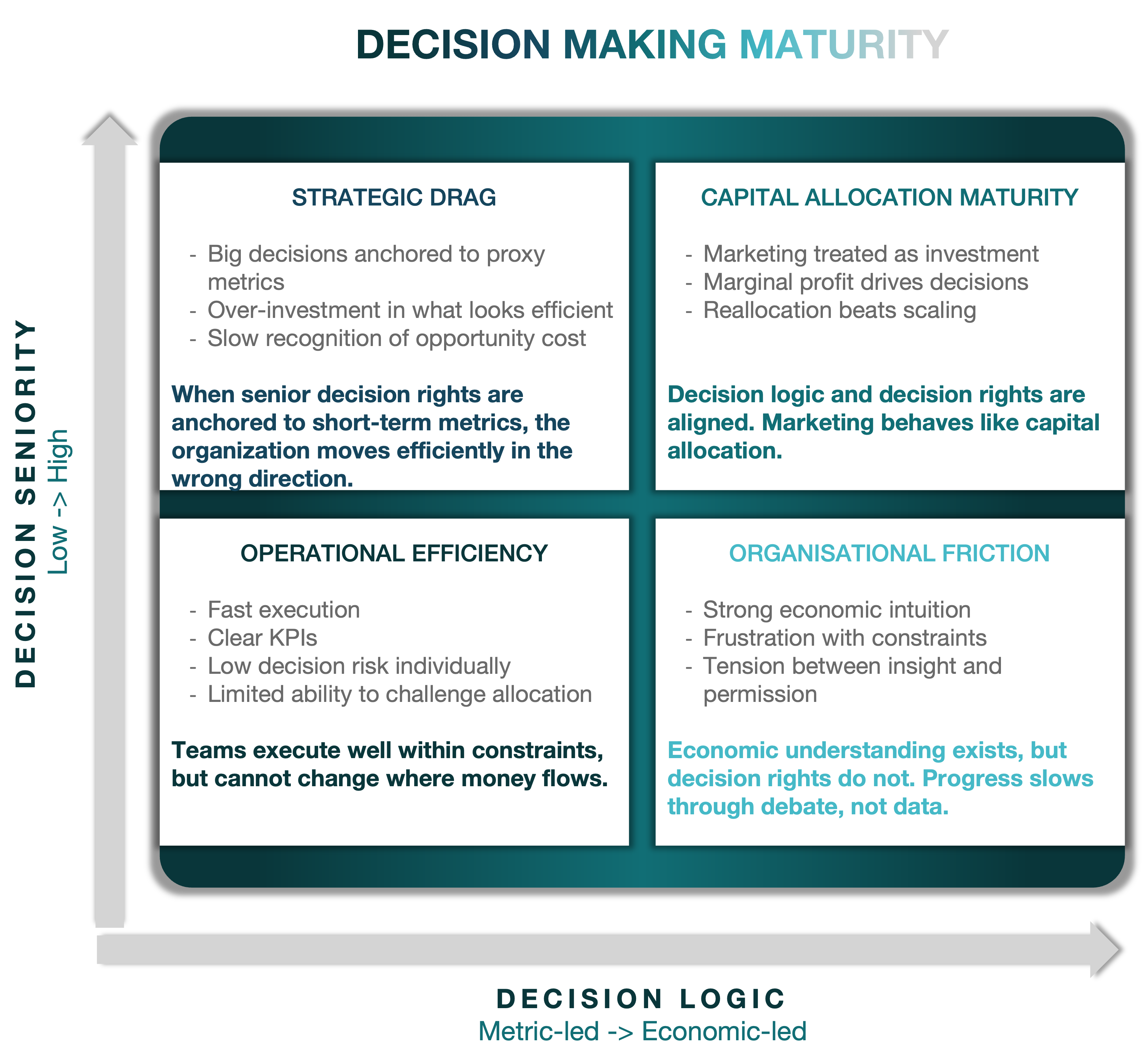
In many organisations, the people who understand the economics cannot move budget.
And the people who can move budget rely on proxy metrics.
This is not a capability problem.
It is a decision-rights problem.
Maturity is not knowing the right model. It is aligning decision logic with decision rights.
AI does not fix bad economics
AI accelerates whatever reward signal you give it.
If the signal is wrong, failure just happens faster.
When money-in-money-out is unclear, AI becomes a risk.
When it is clear, AI becomes a force multiplier. Learning speeds up. Reallocation happens earlier.
AI does not change the question.
It removes the excuse for not answering it.

The closing challenge
You do not need perfect measurement to move up a level.
You need clearer reward signals and better decision logic.
If your organisation cannot clearly answer:
“Why should the next pound go here, instead of somewhere else?”
You are not optimising.
You are reporting.
A quick self-check
If you want to pressure-test how your organisation actually makes these decisions, I have put together a short diagnostic.
It is role-aware, deliberately uncomfortable, and designed to surface misalignment rather than score you.
Take the diagnostic here:
Decision making maturity check
Use it as a mirror, not a verdict
What comes next
This post sets the economic spine.
Next, we will look at what happens when this logic meets real organisations, real incentives, and real power structures — and why misalignment, not ignorance, is usually the constraint.