


The Measurement Problem We Keep Misdiagnosing
Most measurement debates stall at the wrong question: which model is right?
That framing assumes truth lives inside a single system. In practice, every measurement method answers a different question, at a different speed, and under different constraints.
The real failure is not model choice. It is judgement in isolation.
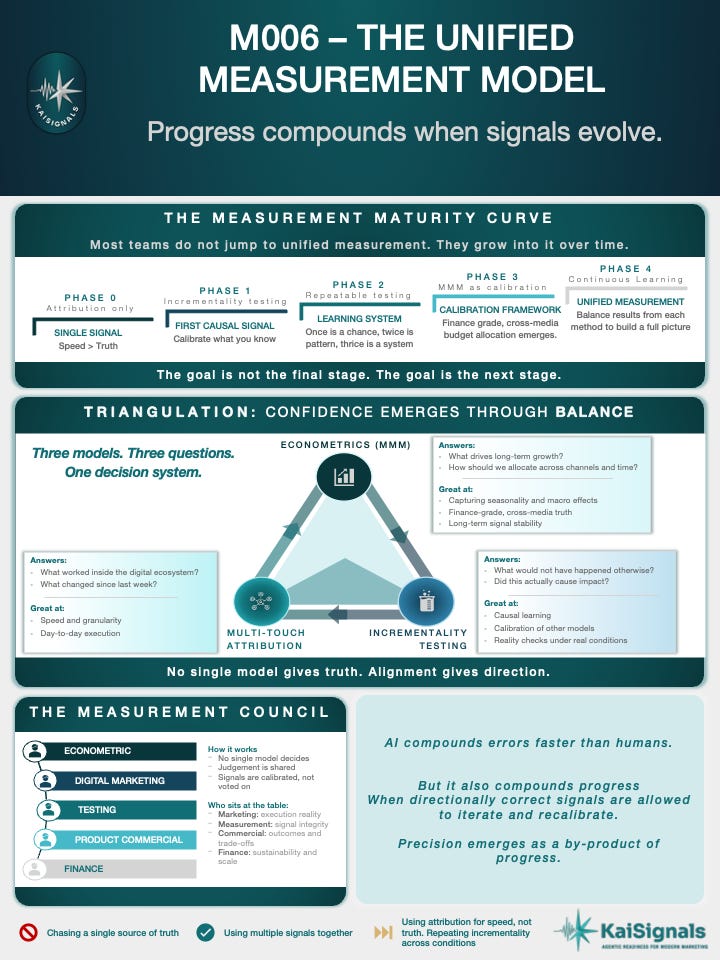
As shown in The Measurement Maturity Curve (see infographic, top panel), teams do not jump to unified measurement. They grow into it by learning which signals are fit for which decisions.
Measurement Maturity Comes Before Measurement Sophistication
Most organisations start with a single signal because it is available, fast, and operationally easy. For digital-first businesses, that signal is almost always attribution.
That is not a flaw. It is a starting point.
What matters is progression. Each stage adds a new signal not to replace the last one, but to correct its blind spots. The goal is never the final stage. The goal is the next stage.
This is why the maturity curve precedes triangulation. Without maturity, triangulation becomes theory instead of practice.
Triangulation Is Not More Measurement. It Is Better Decisions
Once multiple signals exist, the question changes from what does the model say? to how do we decide when they disagree?
The triangulation framework (see infographic, middle panel) makes this explicit:
Attribution answers what is changing now, inside the digital ecosystem
Incrementality answers what actually caused impact under real conditions
Econometrics answers how growth compounds over time and across channels
No single model gives truth. Alignment gives direction.
Why Each Model Fails When Used Alone
Each method breaks when asked the wrong question.
Attribution is fast and granular, but structurally limited to what it can observe. It rewards interaction, penalises proactive channels, and overstates certainty where visibility is partial.
Econometrics is finance-grade and cross-media, but slow. It smooths volatility, lags tactical change, and cannot guide week-to-week execution without external signals.
Incrementality establishes causality, but only at a point in time. Without repetition across seasons and conditions, it becomes fragile and easy to misapply.
These are not weaknesses. They are boundaries.
Progress Beats Precision
Every measurement system produces averages and point estimates. None observe every journey. None control every variable.
Confidence intervals, standard error, and uncertainty are not flaws to be eliminated. They are properties of reality.
Waiting for precision slows learning. Directionally correct signals, recalibrated often, compound progress.
Precision emerges as a by-product of progress, not a prerequisite.
Incrementality as a Learning System
Incrementality is most powerful when treated as a habit, not a proof.
Single tests explain a moment. Repeated tests reveal patterns. Over time, incrementality becomes the calibration layer that feeds both attribution and econometrics.
Lower bounds matter more than point estimates. Design quality matters more than statistical theatre.
This is how causal learning compounds.
The Measurement Council
Unified measurement cannot live inside a single function.
As illustrated in The Measurement Council (see infographic, bottom panel), effective systems share judgement across marketing, measurement, commercial, and finance.
No single model decides. Signals are calibrated, not voted on.
This operating model matters even more in an AI-driven world.
Why This Matters in an AI World
AI compounds errors faster than humans.
But it also compounds progress when directionally correct signals are allowed to iterate and recalibrate.
Unified measurement is not about finding truth. It is about designing systems that learn.
And learning, over time, is what scales.