

The Illusion of Precision in Modern Marketing
If you have been following this series, much of this will sound familiar.
Modern marketing organisations are obsessed with precision. More data. More dashboards. More certainty before action. We return to this theme because it keeps reappearing in different forms.
On the surface, this obsession looks responsible. In practice, it is often the reason progress stalls.
Precision feels safe because it delays commitment. It offers explanation without forcing choice. But as markets, platforms, and customer behaviour evolve faster than our ability to model them perfectly, waiting for certainty quietly becomes a competitive disadvantage.
Across earlier posts, the point has been consistent: the companies that win are not the ones with the most accurate answers, but the ones that learn fastest what to do next.
This chapter builds forward from that premise.
Progress Beats Precision
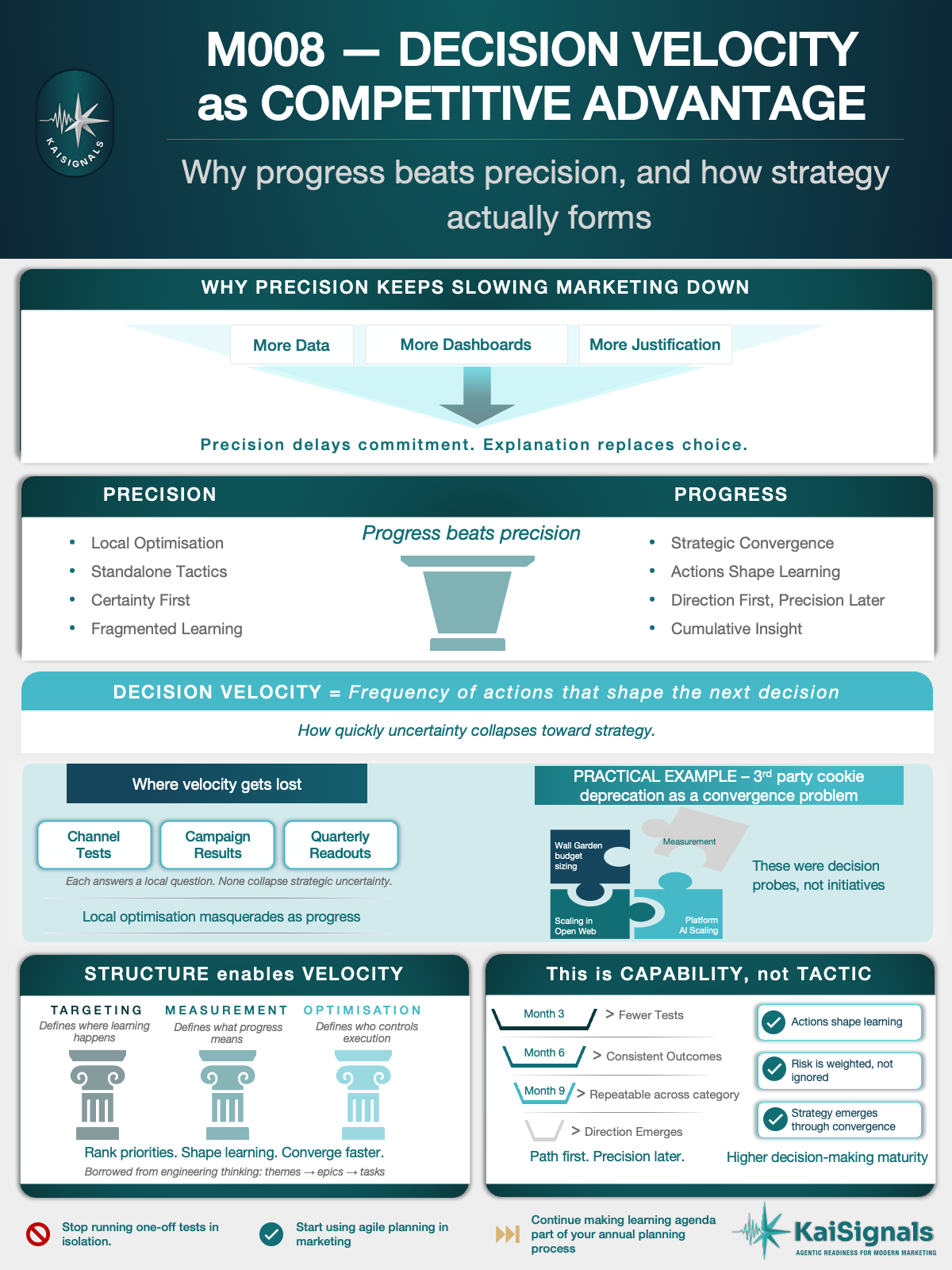
Strategy does not emerge fully formed from analysis. As we have argued before, it emerges through convergence.
Progress is not about being right. It is about moving closer to the right path.
Precision optimises locally. Progress compounds globally.
When organisations optimise for precision too early, they freeze decision-making around narrow questions. When they optimise for progress, they design actions that deliberately shape the next decision, reduce uncertainty, and move the organisation toward a coherent strategy.
This is not a new claim. What is new is how these ideas come together when viewed through the lens of decision velocity, and what that implies for how strategy actually forms.
What Decision Velocity Actually Means
Decision velocity is often misunderstood as speed.
It is not how quickly reports are read, how fast budgets are reallocated, or how rapidly execution happens.
Those are outcomes.
Decision velocity is the frequency with which meaningful actions are taken that shape the next thing to evaluate, allowing the organisation to converge toward a strategic goal.
It is about how quickly uncertainty collapses.
High decision velocity means:
Each action informs the next
Learning accumulates instead of resetting
Strategy becomes clearer over time
Low decision velocity means:
Actions are isolated
Learnings stay local
Strategy remains implicit, assumed rather than discovered
This distinction is subtle, but it changes how organisations decide what to do next.
Why Most Marketing Slows Itself Down
The biggest drag on decision velocity is not lack of effort. It is structure.
Most marketing organisations evaluate tactics in silos:
Channel by channel
Campaign by campaign
Quarter by quarter
Each initiative is optimised locally and judged independently. The assumption is that if enough tactics perform well, strategy will somehow emerge.
It rarely does.
What emerges instead is fragmentation:
Conflicting signals
Competing priorities
Slow, cautious decision-making at leadership level
Local optimisation is mistaken for progress. In reality, it prevents convergence.
The Cookieless Strategy as a Convergence Problem
The move toward a cookieless world was not a channel problem. It was a convergence problem.
The question was not:
Should we invest more in walled gardens?
How do we scale the open web?
Which platforms perform best?
The real question was:
How do we build a coherent marketing strategy for a cookieless world across products and over time?
Initiatives such as right sizing media investment in walled gardens, AI consolidation, and open web experimentation were not standalone projects. They were decision probes.
Each existed to answer a specific strategic question and shape the next one.
Seen in isolation, they look like tactical tests. Seen together, they were pieces of a single puzzle.
Structuring for Velocity: Targeting, Measurement, Optimisation
Decision velocity increased only after the problem was structured properly.
The first deliberate change was to stop testing tactics and start framing strategy around three pillars:
Targeting
How do we reach audiences in a world without cookies?
Measurement
How do we understand how money in becomes money out across ecosystems, products, and time?
Optimisation
Where do we deliberately hand control to platform AI, and where do we intervene?
This structure did not introduce new tools. It introduced coherence.
It allowed priorities to be ranked, not debated endlessly. It ensured every test had a purpose beyond its own result. It mirrored how development teams work: start with the end vision, break it into themes, epics, and tasks, and let learning shape what comes next.
This was the inflection point where learning began to accumulate rather than fragment.

How Learning Compounds When Velocity Is Right
Once structured, learning stopped being episodic and started compounding.
Fewer tests were run, but each one mattered more.
Some tests ran sequentially to preserve clarity. Others ran in parallel, but only when they evaluated the same outcome without polluting interpretation. Results were repeated across products to avoid mistaking flukes for strategy.
At three and six months, interpretation was consistent because the destination had not changed.
By around nine months, convergence was visible:
Fewer funnel stages mattered
An all-in-on-AI direction emerged clearly
Marketing behaviour evolved before final certainty existed
This is what progress looks like when learning compounds rather than resets.
Picking the Path Before Perfecting the Spend
The most important decision was not how much to invest. It was which path to commit to.
Early measurement was intentionally imprecise, but directionally sufficient. It guided the design of tests and the shape of strategy.
Only after the path was clear did precision matter.
This sequence is often misunderstood. Precision is not abandoned; it is delayed until it becomes useful.
Decision Velocity Is a Maturity Signal
Decision velocity is not a tactic. It is a signal of organisational maturity.
When an organisation can:
Design actions that shape learning
Evaluate progress across time and products
Make risk-weighted decisions without waiting for certainty
It has moved beyond optimisation and into strategy-building.
This reflects a different level of sophistication in marketing and measurement decision-making.
The Risk Leaders Still Need to Resolve
Velocity without integration is dangerous.
Moving fast without a coherent decision system leads to chaos, not progress. That raises the uncomfortable question leaders inevitably face next.
If progress comes from faster convergence rather than perfect precision, how do you design a decision system that allows speed without losing control?
Understanding why velocity matters is no longer enough. The unanswered problem is how these ideas are put together in practice, safely and deliberately.
What This Means for Your 2026 Plan
As leaders finalise or execute their 2026 plans, the decision is not whether to move faster.
The decision is how to plan.
Static annual plans assume strategy is already known. Development-style roadmaps assume strategy will emerge through learning.
Leaders should:
Define themes, not fixed answers
Break them into strategic questions
Use sprint-like cycles to shape convergence
This is how progress is engineered.
What Comes Next
This article explains why decision velocity is a competitive advantage.
What it does not explain is how to operationalise it.
That is the next chapter.
If you are trying to translate these mental models into operating systems that run day to day, this is the problem KaiSignals works on.