


Why This Chapter Exists
Most teams believe measurement exists to answer a simple question: “Did it work?”
That framing is too small.
The real question is: “What is the risk-adjusted decision we should make next?”
Precision feels responsible. It feels analytical. But waiting for certainty locks capital, slows learning, and increases opportunity cost. In competitive markets, delayed decisions compound into economic losses.
Once you recognise this, the role of measurement shifts. Precision stops being the goal. Risk shaping becomes the objective.
From Certainty To Expected Value
Every marketing decision is made under uncertainty. Yet many systems behave as if certainty is achievable with enough data.
It is not.
Expected value thinking accepts uncertainty and makes it actionable.
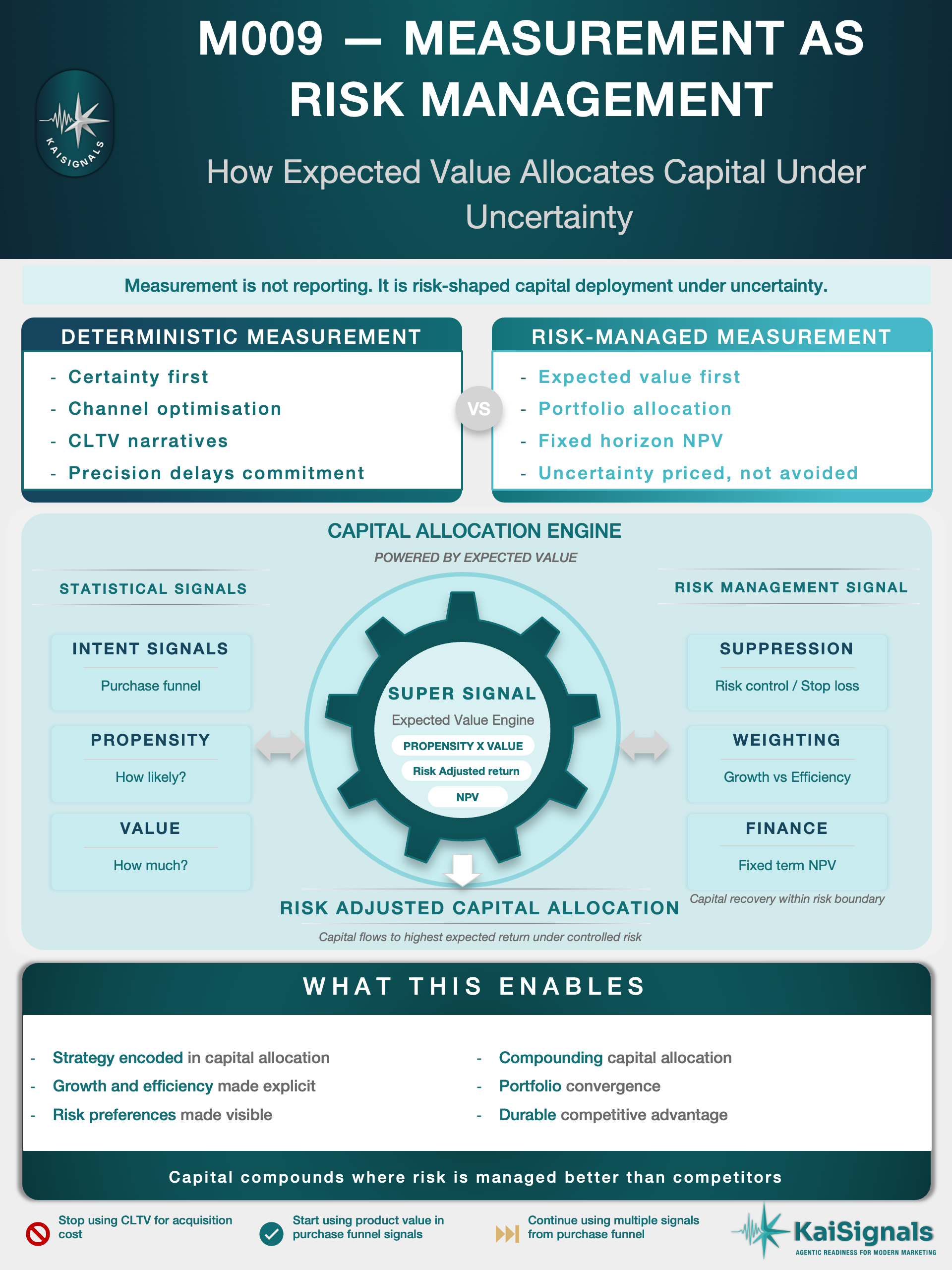
Expected Value = Probability x Value
Measurement is not about finding a single “correct” forecast. It is about comparing distributions of outcomes and choosing the option with the highest expected return.
Deterministic systems optimise for a single projected outcome and wait for validation. Probabilistic systems optimise across a range of outcomes and allocate capital accordingly.
That is why probabilistic systems outperform deterministic ones. They compound learning instead of waiting for proof.
Managing Downside While Scaling Upside
Growth rarely fails because upside was unavailable. It fails because downside was unmanaged.
Risk-managed systems do two things simultaneously:
They cap loss when the signal is weak
They scale aggressively when confidence improves
Unmanaged downside erodes executive trust, triggers budget cuts, and halts experimentation. When losses spike unexpectedly, organisations retreat into short-term defensiveness.
This is why exploration is not waste. It is controlled exposure to uncertainty.
Strong measurement systems make risk visible early, not success obvious late.
Why Precision Is A Distraction
Chasing precision creates false confidence.
Highly precise numbers often:
Arrive too late
Reflect the past
Hide fragility
Precision reduces variance in reporting. It does not reduce variance in business outcomes.
Strategic systems therefore prefer:
Direction over perfect accuracy
Confidence bands over single point estimates
Repeatability over one-off proof
Measurement exists to shape risk, not eliminate it.
The Super Signal As An Expected Value Engine
Once expected value becomes the core logic, the need for integration becomes obvious.
The Super Signal is not a metric. It is a decision engine.
It collapses multiple signals into a single expected value lens:
Propensity answers “how likely”
Value answers “how much it matters”
Super Signal = Propensity x Value
Everything else becomes a modifier.
Without a unifying expected value engine, systems optimise locally. Channels win individually while capital is misallocated collectively.
The Super Signal allows the system to:
Compare unlike opportunities
Trade growth against efficiency explicitly
Move capital to where risk-adjusted returns are highest
Propensity x Value = Risk-Weighted Decisioning
Most optimisation systems favour probability alone. That creates efficiency traps.
High-propensity, low-value outcomes dominate the plan. Low-propensity, high-value opportunities are systematically underfunded.
Risk-weighted decisioning corrects this imbalance.
A lower probability outcome can win if its value justifies the risk. A high probability outcome can lose if its upside is capped.
This is how real investment portfolios are managed. Capital flows to risk-adjusted return, not raw probability.
For example, a high-propensity, low-margin renewal may look efficient, while a lower-propensity, high-margin new product may create more long-term value.
Marketing should operate with the same discipline.

NPV Over CLTV: Finance-Grade Measurement
The critical distinction is not simply discounting. It is horizon discipline.
CLTV typically estimates value across the assumed lifetime of a customer. That lifetime is modelled, uncertain, and often extended far beyond practical decision windows.
A fixed-period Net Present Value reframes the question: What cash flow is generated within a defined payback window?
This matters because risk has a horizon. Capital is allocated within reporting cycles, funding constraints, and strategic review periods.
A fixed payback NPV forces three disciplines:
Time-bounded accountability
Explicit capital recovery windows
Clear comparison across competing investments
CLTV can overstate value by pushing returns into distant, low-visibility periods. Fixed-horizon NPV concentrates on recoverable value under uncertainty.
That makes it superior for real-world decision making, where capital is finite and risk tolerance is time-bound.
When measurement moves to fixed-horizon NPV, marketing stops forecasting stories and starts competing for capital on recoverable returns.
Signal Weighting Is A Strategic Choice
Once decisions are framed in expected value terms, signal weighting becomes unavoidable.
Signal weighting is not technical hygiene. It is strategy encoded.
Heavier weighting on early signals biases the system toward growth. Heavier weighting on later signals biases it toward efficiency.
There is no neutral configuration. Every system embeds a tradeoff.
Implicit weighting embeds hidden risk preferences that executives did not explicitly choose. Unseen risk preferences distort capital allocation.
Mature organisations choose these weights deliberately. Immature ones inherit them accidentally.
Suppression As Downside Risk Control
As systems scale, the question becomes not only where to invest, but where not to.
Suppression is not optimisation. It is protection.
It prevents:
Overexposure to low-confidence segments
Waste during signal decay
Feedback loops that amplify noise
It preserves signal integrity and capital discipline. Without suppression, systems overfit noise and amplify variance.
In risk terms, suppression is a stop-loss mechanism.
Growth systems without suppression do not fail slowly. They fail catastrophically.
What This Changes In Practice
When measurement is treated as risk management:
Tests become learning instruments rather than scorecards
Precision gives way to confidence intervals
Budgeting becomes capital allocation
AI optimises portfolios rather than channels
Because uncertainty is quantified rather than avoided, decision cycles shorten. Capital compounds faster than competitors.
Closing Thought
The goal of measurement is not to be perfectly right. It is to be less wrong, faster, at scale.
Risk-managed systems allocate capital with discipline under uncertainty.
Capital compounds where risk is managed better than competitors.
Thanks for reading KaiSignals! Subscribe for free to receive new posts and support my work.
If you are trying to translate these mental models into operating systems that run day to day, this is the problem KaiSignals works on.