


The Comfortable Trap
There is a question that comes up in every budget conversation. It sounds like this: “Why are we spending money on things that are not proven?”
It is a fair question. Every pound in the media plan carries an expectation. Commercial targets are set before budgets are designed. Every allocation that does not point directly at those targets needs a defence. The scrutiny is not irrational. It is how organisations manage finite resources under pressure.
But the question carries a hidden assumption. It frames proven activity as productive and unproven activity as waste. And in doing so, it creates a system that rewards exploitation - the scaling of what already works - while quietly starving the only mechanism that finds what comes next.
This article is about that mechanism. We call it exploration. And the argument is not that it is nice to have. The argument is that without it, the ceiling gets lower every year, and nobody notices until it is too late.
(For the foundations behind this, see M009 on measurement as risk management and M010 on how confident outputs create false confidence in the people who use them.)
Every Efficient System Eventually Saturates
Exploitation feels safe because the numbers confirm it. You are spending within a proven strategy. The cost per acquisition is within target. The return on spend is stable. Nothing appears to be wrong.
But exploitation operates within a fixed ceiling. It optimises the space it already knows. It does not expand that space. And when the ceiling is reached - when the headroom within proven strategies runs out - the decline is gradual, not sudden. There is no single moment of failure. There is no red flag in the weekly trading report. The numbers simply get harder, week by week, and the team works longer hours to deliver the same outcomes from a shrinking territory.
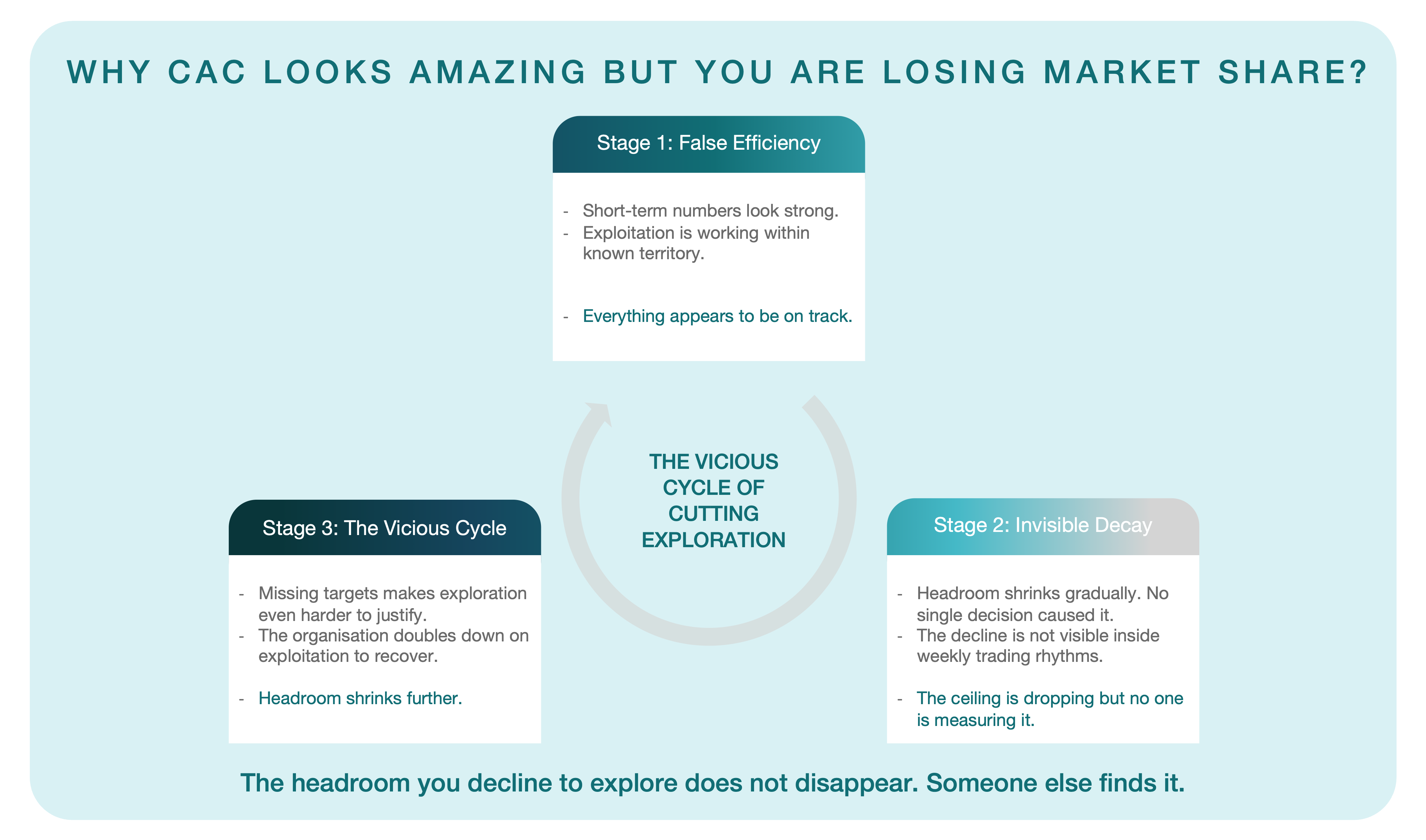
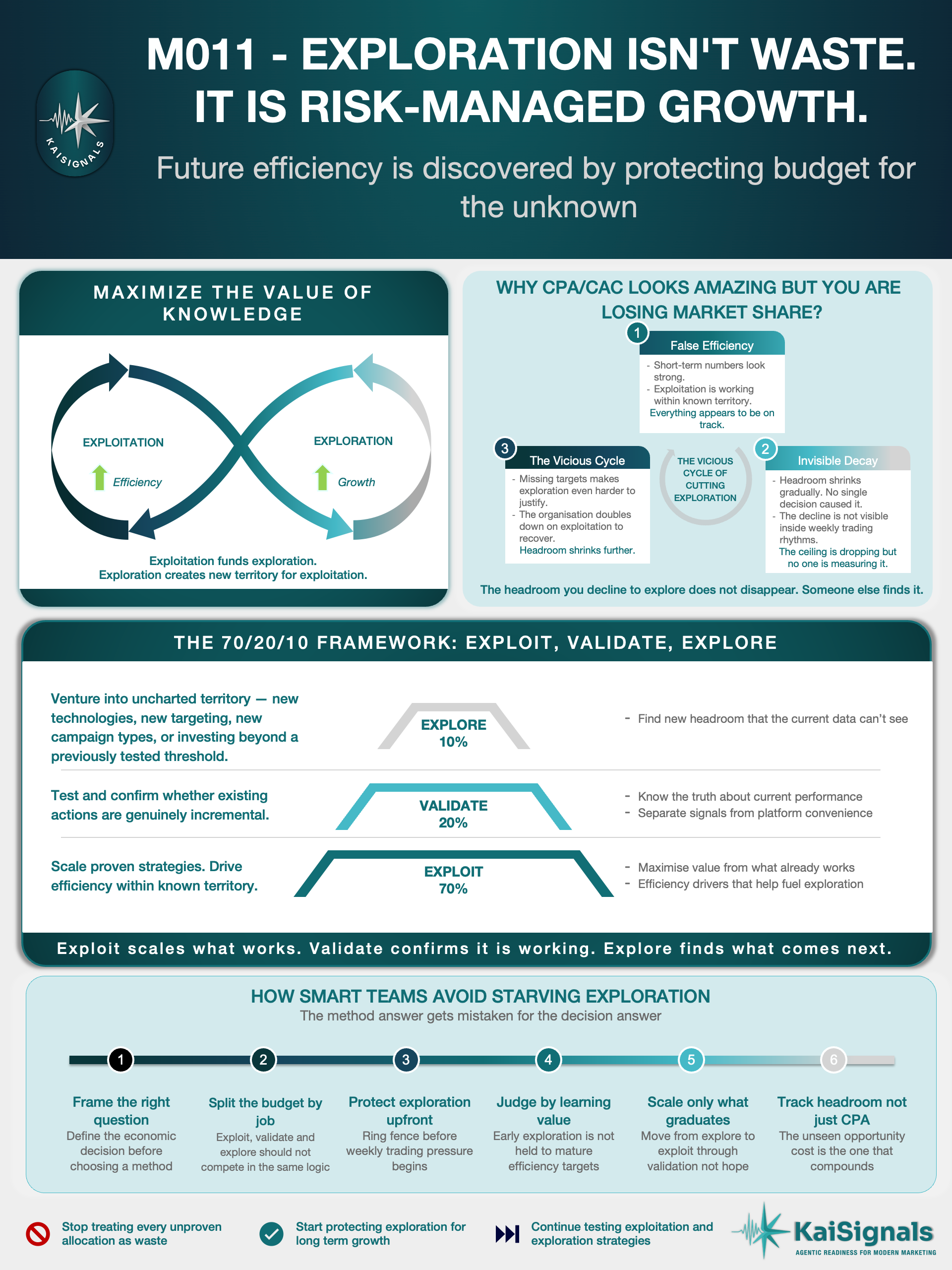
This is the first stage: false efficiency. Everything looks right while the underlying capacity to grow is quietly contracting.
The second stage is invisible decay. Headroom shrinks without being measured. No dashboard tracks it. No weekly report names it. The trading team is responding to the signals it has been given, and those signals all point inward - toward the things that are already working. The things that are not yet known remain invisible because no budget has been allocated to finding them.
The third stage is the vicious cycle. When targets are missed - and they will be, because the headroom has been running out - the organisation doubles down on exploitation. The logic is understandable: we are behind target, so we need to spend more on what works. But what works is precisely what has already been exhausted. The response to stagnation accelerates it.
The competitive endpoint is the part most organisations miss. The headroom you decline to explore does not disappear from the market. It sits there. And a competitor who is willing to look for it will find it. The territory you vacated becomes their growth.
Exploration Is Not Testing
Before going further, a distinction that matters more than it appears to.
The industry tends to use “exploration” and “testing” as if they are the same activity. They are not. They serve different strategic purposes, carry different risk profiles, and answer different questions.
Exploitation is scaling what works. It drives efficiency by reducing wastage within proven strategies. The question it answers: how do we get more from what we already know?
Validation is testing whether what you already do is genuinely working. This is the incrementality question. Conversion Lift studies, geo-lift tests, matched market experiments - these are validation tools. They evaluate the value of existing actions. The question they answer: is what we think is working actually working?
Exploration is venturing into territory that current data cannot map. New technologies, new targeting methodologies, new campaign types, or investing materially beyond a previously tested threshold. It does not come with a guaranteed return. That is its defining feature. The question it answers: what else is out there that we have not yet found?
Testing is an evaluation tool. It serves both exploitation and exploration. You need to test to validate what you already do. And you need to test to evaluate whether the new territory you explored is worth staying in. But testing is not the same as the strategic decision to explore in the first place.
Rick Bruner makes a related argument. The cost of not knowing whether your current spend is incremental almost always exceeds the cost of finding out. That is the economic logic for validation - and it is a strong one. Exploration extends that logic further. The cost of never looking for new headroom is not a line item anyone reports. It shows up as stagnation that nobody saw coming.
Why Reporting Over-Rewards Exploitation
The measurement system itself is part of the problem.
Last-click attribution rewards the channels closest to the conversion. By definition, those are exploitation channels - the tactics that harvest demand that already exists. Reach campaigns, new-audience targeting, and upper-funnel exploration look wasteful in attribution reporting because they are not close to the sale.
This is not a flaw in the tactics. It is a flaw in the measurement frame.
An organisation that evaluates all spend through a single attribution lens is structurally biased toward exploitation. The signal it receives tells it to scale what converts and cut what does not appear to. The problem is that the things that do not appear to convert are often the things generating the demand that the conversion channels are harvesting.
(This connects directly to M010. The data is not wrong. The frame is. And when the frame rewards exploitation by design, exploration never gets a fair hearing.)
The consequence is that even well-run teams with good measurement practices will systematically under-invest in exploration unless they make a deliberate structural decision to override the signal. Attribution does not lie. But it only tells one part of the story. And the part it leaves out is exactly the part that creates future growth.

What Happens When You Explore
Two examples from my own experience. Both involved genuine uncertainty going in. Both produced results that no amount of exploitation within the existing structure would have revealed.
Exploration through scale.
A media team had historically under-invested in a high-value product category. No recent econometrics baseline existed. All directional signals pointed to more headroom, but the default was under-investment - because in the absence of a modelled baseline, the safe choice was to hold steady.
The team took a deliberate decision to double the budget and ran a matched market test to measure the impact. The incremental lift between test and control showed that even at twice the spend, the average cost per incremental acquisition remained well within the profitability threshold.
The headroom had been sitting there. Nobody had gone far enough to find it. That is not a failure of analysis. It is a failure of allocation. The exploitation strategy was performing well within its known ceiling. But the ceiling was far lower than the actual opportunity.
Exploration through structural change.
An organisation modelled a nearly 10% sales loss from consolidating its advertising partner ecosystem - reducing from many partners down to two. The econometrics data supported that risk estimate. The team carried that quantified downside into the test.
The result was the opposite of what the model predicted. Not only was there efficient headroom within the consolidated partners, but scaling created economies of scale the fragmented model had been actively preventing. The old structure - spreading budget thinly across a large partner set - was not reducing risk. It was reducing performance.
Both examples follow the same pattern. Quantified risk going in. Surprising upside coming out. And results that could not have been found without the willingness to explore territory that the existing data could not see.
When Exploration Becomes an Afterthought
The examples above required a deliberate decision to override the default. That is the hard part.
In most organisations, the default works against exploration at two levels simultaneously.
At the planning stage, budgets are designed against commercial targets. Every allocation is expected to contribute to those targets directly. If the proposal is 70% exploitation, 20% validation, and 10% exploration, the 10% is the part that faces the deepest scrutiny. It does not come with a guaranteed return. It does not point at a forecast. It asks the organisation to accept that spending money on the unknown is a structural requirement, not a discretionary luxury. That is a hard argument to win when every other line in the budget is anchored to a number.
At the implementation stage, teams managing weekly trading pressure feel the constraint differently. They are accountable for targets that reset every week. Holding budget in strategies that are not visibly contributing to this week’s performance is difficult when the gap between actual and target is widening. The argument that exploration pays off in the long run is hard to hear when you are the person staring at a shortfall today.
These two levels compound each other. The budget is designed without protected exploration spend. The team, under weekly pressure, allocates everything to what is working now. Exploration does not get cut with a single decision. It gets crowded out by the accumulated weight of short-term trading logic.
Every senior marketer will recognise this pattern. Shrinking budgets. Growing targets. Exploration as the first thing that yields when the pressure increases. And the quieter consequence: year on year, the organisation’s knowledge of its own opportunity narrows.
AI Systems Only Optimise What You Tell Them to Optimise
There is a common assumption that AI solves the exploration problem. It does not.
AI conversion tools - ASC, PMax, and their equivalents - are exploitation engines. They are given an objective, most commonly to maximise sales, and they find the cheapest path to that objective within the space they can see. They are very good at this. That is exactly the problem. An AI system told to maximise sales will never choose to expand its own universe. It will find the most efficient route through the territory it has been given and call it the answer.
That answer is a local maximum. It is the best result available within the current space. It is not the best result available.
Exploration in AI-led marketing requires a different architecture. Reach campaigns, Demand Gen, and upper-funnel formats are AI technologies that do a different job. They expand the universe of people who have seen the brand - people who have never been exposed to the product, the offer, or the message. They create new territory for the exploitation engines to work within.
This maps directly to the framework established in D003: the only two strategies that matter are reach and conversion. Reach expands the surface area. Conversion increases density within it. Exploration is the reach strategy applied at the investment level.
The structural point: the exploration layer is a human design decision. AI will not create it by itself. If you do not architect your campaign structure to include exploration technologies alongside exploitation technologies, the system will converge on what it already knows. And what it already knows will, over time, become less and less of what is actually available.
The 70/20/10 Discipline
The argument so far has been about why exploration matters. This section is about how to protect it.
The 70/20/10 framework is not new. Larry Page popularised it at Google as a product development principle. Jonathan Mildenhall adopted it at Coca-Cola for marketing investment. Research by Nagji and Tuff in Harvard Business Review found that the allocation pattern - roughly 70% core, 20% adjacent, 10% transformational - correlated with meaningfully higher share price performance across the companies that practised it.
What is less common is applying it with the right labels. Most versions of the framework describe the 20% and 10% tiers as variations of “innovation.” That is too vague. It conflates two activities that serve different purposes.
The sharper model is this:
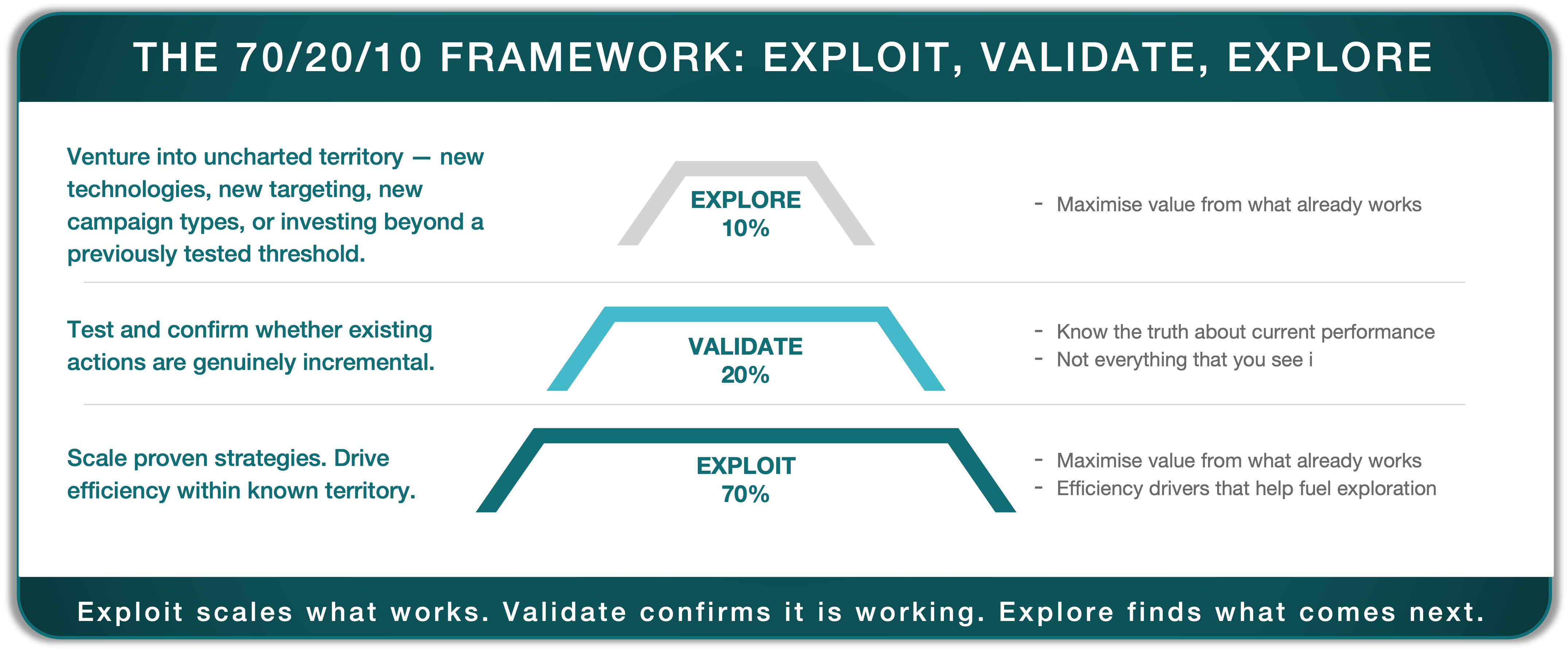
70% Exploit. Scale proven strategies. Maximise efficiency within known territory. This is where the majority of commercial targets are delivered.
20% Validate. Test and confirm whether existing actions are genuinely incremental. This is where incrementality testing, Conversion Lift studies, and matched market experiments live. The goal is not innovation. It is truth - knowing whether what you are doing is actually working.
10% Explore. Venture into genuinely uncharted territory. New technologies, new targeting methodologies, new campaign types, or investing beyond a threshold you have not previously tested. This allocation is deliberately small. It does not require a large budget. It requires a protected one.
The critical governance principles:
The 10% exploration budget is not discretionary. It is structural. It is ring-fenced before the trading cycle begins - not allocated from whatever is left after exploitation has taken its share.
It is evaluated on different criteria than the 70%. Exploration is not held to mature efficiency targets. It is judged by learning value - the quality of the question asked and the usefulness of what was discovered. An exploration investment that reveals there is no headroom in a new channel has succeeded. It answered the question. An exploration investment evaluated on CPA in its first quarter has been set up to fail.
Without that protection, exploration is the first casualty of every budget pressure cycle. And once it is gone, the vicious cycle from Section 2 begins.
What This Looks Like on Monday Morning
The action is specific. Look at your media plan. Ask three questions:
What portion of your budget is allocated to exploit - scaling what you already know works?
What portion is allocated to validate - confirming whether those strategies are genuinely incremental?
What portion is allocated to explore - venturing into territory that current performance data cannot see?
If those distinctions are not explicit in your plan, the default is almost certainly 100% exploitation. Exploration is happening accidentally, if at all. And validation - the discipline of checking whether exploitation is genuinely productive - is probably not happening systematically either.
Then ask a fourth question: are you tracking headroom, or only efficiency? CPA tells you how cheaply you are acquiring within the space you already know. It does not tell you whether that space is shrinking. Headroom - the distance between where you are spending and where diminishing returns begin to bite - is the metric that tells you whether your growth capacity is expanding or contracting. If you are not tracking it, you will not see the ceiling until you hit it.
The question is not “should we explore?” The question is: do you know, right now, what percentage of your budget is protected for exploration? And is it protected structurally - ring-fenced before the trading cycle starts - or is it the discretionary line that gets cut first when pressure increases?
The Data MMM Needs Most
This article has argued that exploration is not the opposite of efficiency. It is how future efficiency is discovered. Without it, the ceiling lowers, the headroom shrinks, and the organisation converges on a local maximum that feels like the answer but is not.
The next article in this series, M012, will argue that Marketing Mix Modelling is useful but not perfect. MMM tells you where spend has worked historically. It shows you the trends, the curves, the diminishing returns within known tactics. What it cannot tell you is where the ceiling is, or whether a tactic you have never tried has headroom you have not yet measured.
That gap - between what MMM can see and what actually exists - is exactly what exploration fills. The data that makes MMM most useful is the data that only exploration can generate.
Exploration is not the cost. Stagnation is the cost. The headroom is there. The question is whether you are willing to look for it.
If you are trying to translate these mental models into operating systems that run day to day, this is the problem KaiSignals works on.