


The Efficiency Trap
Media budgets have been shrinking for a few years now, while sales and profit targets keep climbing. Every planning cycle carries the same instruction. Find the efficient channels. Pull money out of the ones dragging the average down.
It sounds disciplined. Often it is the opposite. Pull too hard on a channel and it drops below the spend it needs to work at all. The efficiency it loses is larger than the saving you made. The move meant to protect the numbers quietly weakens them.
So the real question is not which channels to cut. Every tactic, every strategy, every channel we put media behind warrants one question. Are we right-sized? Enough spend to perform, and no more than the channel is able to use well.
Most teams only ever ask the top end of this. How much more before returns fade. Under shrinking budgets, the damage nobody sees sits at the other end. This piece is mostly about the floor, the point below which spend stops working, because it is the more common mistake and the more expensive one.
(For the foundations behind this, see M005 on Money In, Money Out. For the cycles of consolidation and diversification, see D009. This chapter continues in M020 and M021.)
The Tool We Reserve for Planning and Forget on Monday
Growth curves hold a strange place in most teams. We reach for them once or twice a year, in the annual plan or the quarterly reset, to decide where the big money goes. Then we put them away. By Monday, when the trading desk is moving budget between channels, the curve is nowhere in the room.
This is the moment it matters most. Efficiency is not a fixed property of a channel. It moves along the spend curve as you scale up and down. A channel is not simply efficient or inefficient. It is efficient at one level of spend and wasteful at another. The single number coming off a platform hides all of this.
The habit it breeds is costly. When a channel looks weak, the instinct is to remove the investment rather than decrease it. Remove versus decrease is not a small distinction. One kills a channel outright. The other moves it to a better point on its own curve. The blindness works in reverse too. A channel performing well pulls in more money, and the rising CPA of scaling it goes unrecorded, because nobody is reading the slope.
Too Little Is Not Safe. It Is Idle.
Here is the part most planning misses. A budget set too low is not a careful budget. It is an idle one. The money is still being spent, it is simply working at a fraction of its strength.
The fallacy is a comfortable one. We tell ourselves spending less makes us more efficient. Below a certain level it does the opposite. With too little in the channel, the platform struggles to find enough of the right people, and the ones it does find get more expensive to reach. We set out to protect efficiency and end up eroding it.
This floor has a name worth keeping. The minimum performant spend. It is the level a tactic needs to reach before it starts working at all. Below it, you are not saving money. You are stranding it.
Why the Machine Needs Fuel
None of this is mysterious once you see how the platforms work. A platform optimises to find the best outcome from the pool of people available to it. Constrain the budget and you shrink the pool. A smaller pool gives the optimisation less to work with, so it has to work harder to find the right people, and working harder costs more. The floor is mechanical, not a matter of luck.
There is a pricing detail underneath this worth stating plainly. Digital media is bought on a delivery basis. Display and social are priced on impressions, search on clicks. But we judge performance on an outcome, the CPA, which sits on the far side of a conversion step. Between showing an ad and winning a customer there is a gap, and closing the gap efficiently needs enough people in the pool to begin with. Starve the delivery and the conversion step has nothing to work with.
This is the same idea as reach and conversion from D003. You need enough surface area for conversions to be found within it at a sensible cost. Too little surface area, and the most valuable step in the chain, turning delivery into outcomes, quietly breaks.
The Asymmetry That Makes the Floor Dangerous
If underspending and overspending were equally easy to fix, none of this would matter much. They are not. The two errors correct in opposite ways, and this is the heart of the argument.
Overinvest, and the CPA rises as you scale. The fix is to pull money back, which is exactly what instinct tells you to do. The system self-corrects. Overspending is a mistake with a built-in alarm.
Underinvest, and the opposite happens. The channel looks weak, so instinct says cut. Cutting drops it further below the floor, efficiency falls again, and the cut looks justified. It is a downward spiral, and the only way out is the one nobody reaches for. Spend more behind something apparently not working. Because the right move is counterintuitive, good strategies get quietly killed. Instinct corrects the top of the curve and sabotages the bottom.
What COVID Showed Me
I first saw this clearly during COVID, and I saw it in a signal I did not fully trust. Watching paid search week to week, lowering spend pushed the CPA up, and putting spend back brought it down again. By moving budget around, you saw efficiency travel with it, in the opposite direction to the cut.
I want to be honest about what this was and was not. It was the middle of a pandemic, with demand and auction prices swinging on their own from one week to the next. It was reported CPA, not a clean incremental read. It was not a test. It was an observation, the kind which makes you curious rather than the kind you bank.
But it pointed somewhere real. If a channel were on a purely diminishing curve, CPA would only rise as spend grew. Seeing it fall as spend rose said something else was happening at the low end. The observation hardened into a discipline I have carried since. Before scaling anything, find the minimum performant spend. This discipline is what led to the test.
The Test: Minimum and Maximum Per Tactic
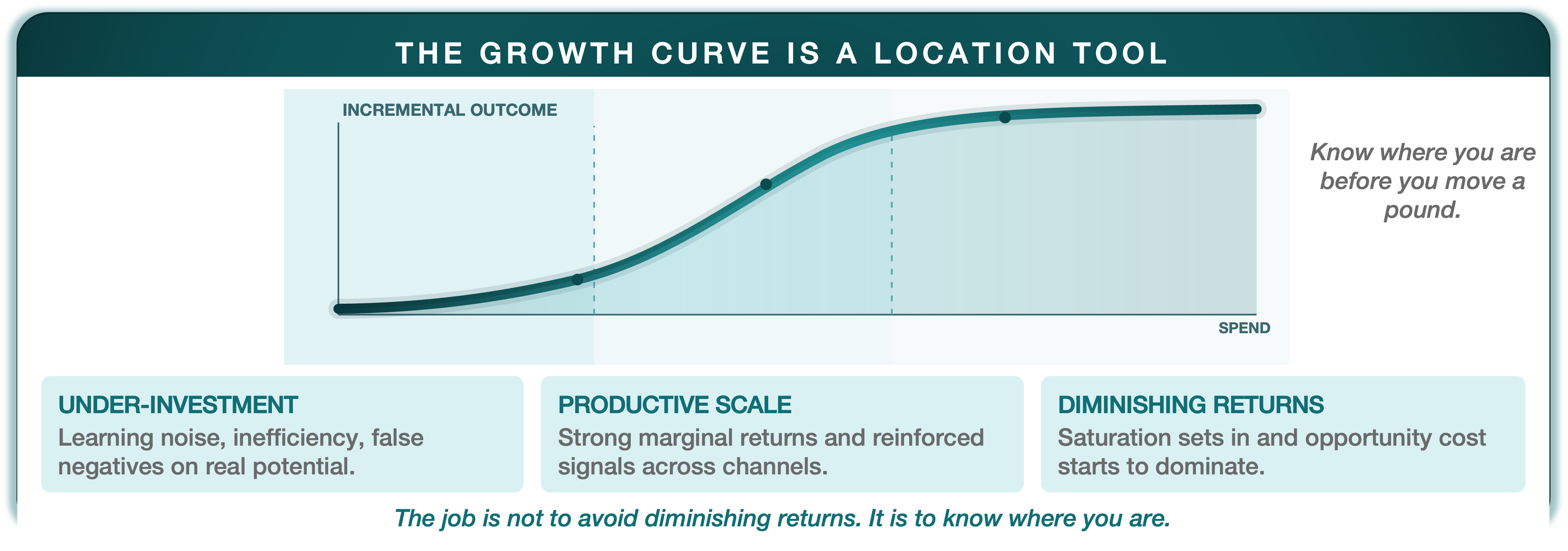
The discipline turned into a brief. I asked the platform measurement team to estimate the minimum and maximum spend for each tactic. Framed this way, the growth curve becomes more useful than a shape. It becomes a floor-and-ceiling map. The minimum is where a tactic starts performing. The maximum is where it saturates and the next pound is wasted.
Here is the honest part. We built the test on a concave assumption, the standard one in the literature. Start at zero, spend some and get some sales, spend more and get more, with each extra pound doing a little less than the last. One tactic broke the assumption. Its curve stayed shallow at low spend, then bent upward and kept accelerating rather than flattening. We had gone looking under a diminishing-returns assumption and found a floor we had not expected.
That upward bend is the thing this whole piece is about. Below it, spend is inefficient because the pool is too thin for the optimisation to work. Above it, the tactic finds its stride. And the slope of the curve is worth reading directly, because the slope is your CPA. A steep slope means each pound is buying more, so the cost per outcome is low. A shallow slope means the opposite.
A word on confidence, because the estimates are not all equally firm. Some came back with wide bands and deserve more work before a large call is made on them. But precision was never the point. Direction was. Knowing one level performs, knowing a higher level also performs, and knowing the marginal CPA between the two is acceptable, is enough to earn permission to operate in that range. Progress over precision, as the earlier pieces put it.
The three tactics we measured turned out to sit in three different parts of the curve. What follows from this, and how you allocate across curves that disagree, is where M021 begins.

Finding Your Floor This Week
You do not need a commissioned study to start. The direction of travel is readable in the accounts you already run. Move a budget and watch which way the marginal CPA goes.
Cut a tactic and see the CPA climb, and you have gone too far down. You are at or below the floor, and the answer is to reverse the cut, not deepen it. Add budget and watch the marginal CPA on the new spend jump, and you are at or over the ceiling, where the money belongs elsewhere.
Two habits follow. First, run the remove-versus-decrease test on every underperformer before you switch it off. A weak read is sometimes an underfunded one. Second, when you trial a new tactic or diversify into a new platform, fund it past its floor before you judge it. An underfunded test is not a verdict. It is a non-result dressed as one.
This is where consolidation and diversification meet the curve, the cycles I wrote about in D009. Whichever way you are moving, the budget is finite and split across tactics. Each one faces the same two questions. What is the minimum to make this work, and how far is it able to go.
Know Where You Are
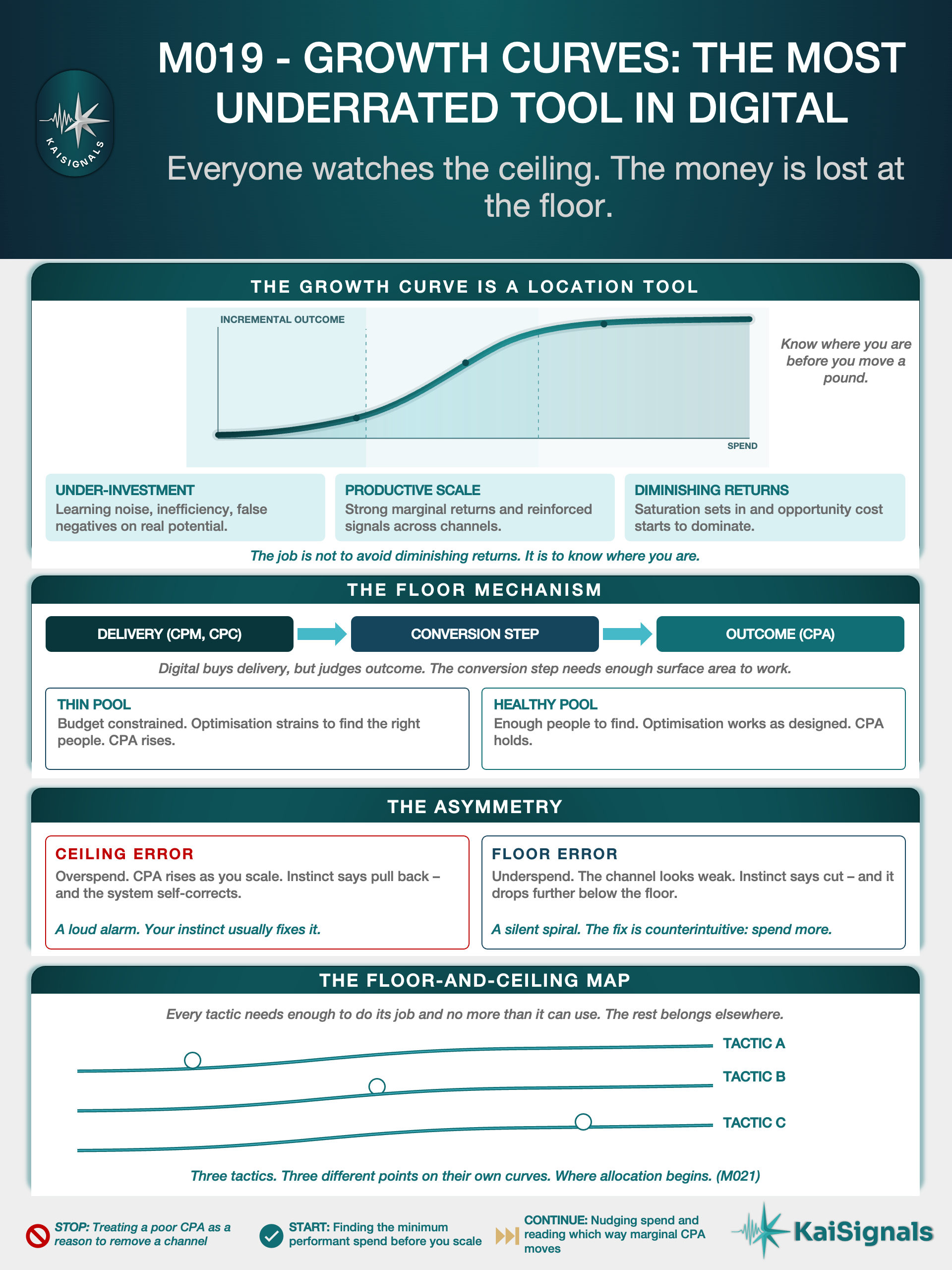
Budget is finite whether you consolidate or diversify. Every tactic needs enough to do its job and no more than it can use. The rest belongs elsewhere.
If you take three moves from this piece, take these. Stop treating a poor CPA as a reason to remove a channel. It is a reason to right-size it, down if overinvested, up if underfed. Start finding the minimum performant spend for every tactic before you scale it. And continue nudging spend and reading which way the marginal CPA moves, because it points you to both the floor and the ceiling.
The curve on this page came from a test. In practice you do not wait a year for one. You build a living version from the platform data you already have, calibrated against your MMM and your experiments, and you use it to decide where the next pound goes. This is where M020 begins.
If you are trying to translate these mental models into operating systems that run day to day, this is the problem KaiSignals works on.