
M013 - Attribution: Flawed but Foundational
The measurement method everyone criticises and no one stops using - because nothing else operates at the speed of the business.


The Wheel, the GPS, and the Road
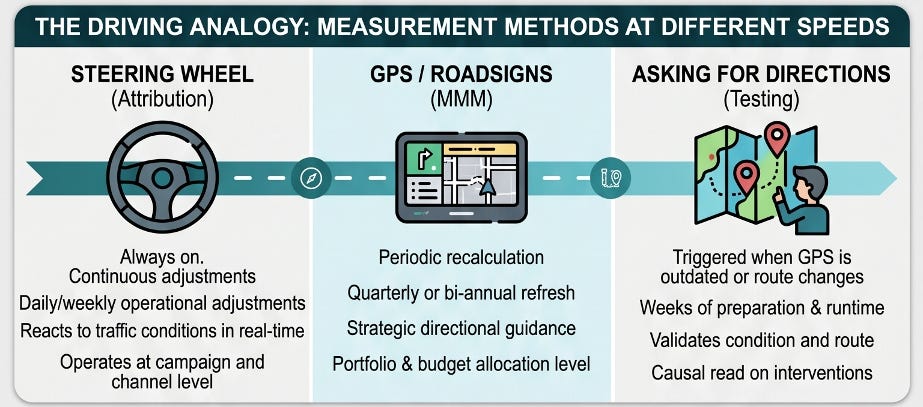
Think about driving a car.
The steering wheel is in your hands the entire time. You make constant, small adjustments based on what you see in front of you. Traffic slows. You brake. A lane opens. You move. The decisions are continuous and reactive. They keep you on the road moment to moment.
The GPS sits on the dashboard. It recalculates periodically. It tells you the direction of your destination, which turns to take, and how far you have left. It does not tell you about the traffic in front of you. It does not tell you when to brake. It operates at a different speed and a different scale.
And sometimes the GPS is wrong. The route it recommends is outdated. The road is closed. A new bypass has opened that the map has not registered yet. When that happens, you stop and ask for directions. You get a fresh read on conditions. You recalibrate the GPS and adjust your route.
This is how the measurement system works.
Attribution is the steering wheel. It is in your hands every day, every week. It tells you what is happening in your campaigns right now - which channels are contributing, how customers are arriving, where performance is shifting. It keeps you on the road at the operational level.
MMM is the GPS. It recalculates quarterly, sometimes annually. It tells you the direction of your budget - where to invest more, where returns are diminishing, which portfolio mix gets you closer to the destination. It operates at the strategic level. (For more on this, see M012.)
Testing is asking for directions. It is triggered when the GPS is outdated, when the road has changed, or when attribution and MMM disagree. It takes preparation. It takes time. It gives you the most reliable read on actual conditions. (For the foundations behind experimentation, see M007.)
The steering wheel needs the GPS to know where to go. The GPS needs direction checks to stay current. All three are needed to reach the destination. None of them replaces the others.
This article is about the steering wheel. It is about why attribution - the most criticised measurement method in the industry - is also the one no team stops using. And why that is not a contradiction.
Three Layers, Three Views, Three Blind Spots
The word “attribution” gets used as if it describes one thing. It does not. There are three distinct layers, and most teams conflate them.
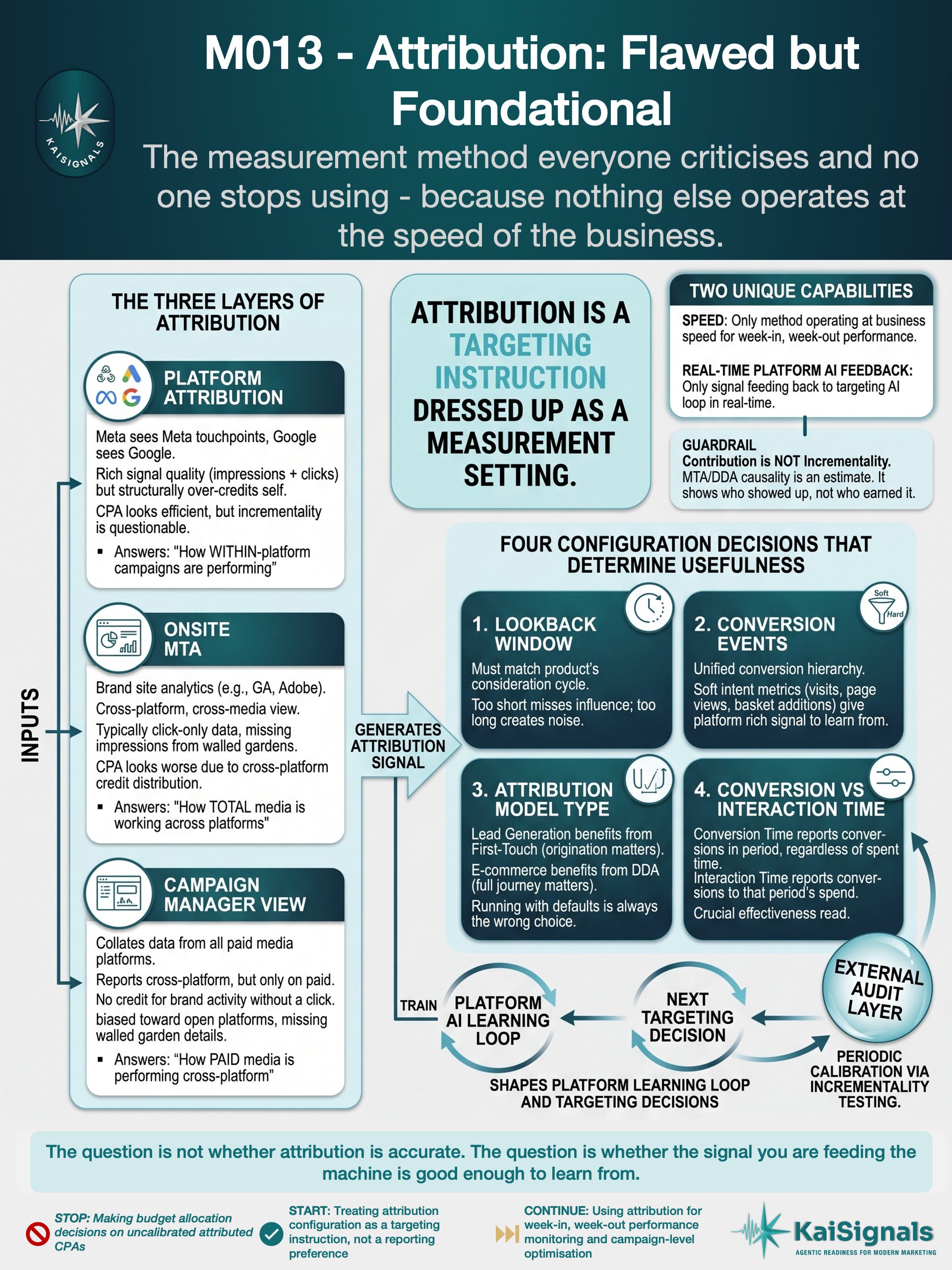
Platform attribution operates inside a single ecosystem. Meta sees all Meta touchpoints for a given individual - impressions and clicks. Google sees all Google touchpoints. Each platform assigns credit within its own walls. Because it only sees its own part of the journey, it over-credits itself. The CPA it reports looks efficient because the denominator is inflated. But it also has the richest signal quality of the three layers - it sees impressions alongside clicks, not clicks alone.
The over-crediting is not a defect. It is a structural feature. If most of your target audience uses Meta, Meta will be present in most customer journeys and will show contribution to all of them. The credit it claims is proportional to its presence, not its incremental effect.
Onsite MTA sits at the brand site analytics layer - GA, Adobe, or a similar platform. It tracks touchpoints that arrive at the brand’s website and builds a cross-platform, cross-media view. This is the fuller picture. But it is typically limited to clicks, because impression data from walled gardens does not pass through to the brand site. The CPA here looks worse than platform-reported CPA because credit is distributed across all contributing platforms rather than each one claiming the full conversion. Getting impression data through clean rooms is technically possible but has to be solved one walled garden at a time. The effort-to-reward ratio makes it impractical at scale for most organisations.
The campaign manager view collates data from all platforms and reports cross-platform attribution, but only on paid media. It does not credit brand activity or upper-funnel and mid-funnel work unless there was a click. It has more data coming from open platforms like Google than from walled gardens, where only click data is available.
Each layer answers a different question. Platform attribution tells you how campaigns within a platform are performing. Onsite MTA tells you how your total media is working across platforms. The campaign manager view tells you how paid media is performing cross-platform. None gives the complete picture. And the CPA you see in each is a fundamentally different number.
The methodologies themselves - last-touch, linear, U-shaped, data-driven - are how you evaluate. But the premise underneath them matters more. The lookback window, which touchpoints are included, which platforms contribute data - these change the meaning of the output. The evaluation method matters less than the inputs it is working with.
The Mechanism Nobody Talks About
Attribution is not a reporting layer. It is the operational infrastructure that targeting and optimisation run on.
When a platform like Meta or Google optimises a campaign, it uses conversion signals to learn who to target next. That learning loop runs on attributed conversions. The platform sees which individuals converted, traces back which touchpoints they interacted with, and uses that pattern to find similar individuals for the next ad impression.
This means attribution is not a measurement choice a marketer makes after the campaign runs. It is embedded in the campaign’s ability to find the next customer while it runs. The attribution configuration determines the signal. The signal determines who the platform targets. The targeting determines the result.
Attribution is a targeting instruction dressed up as a measurement setting.
This is what makes attribution foundational despite its limitations. You do not have to believe it is perfectly accurate to recognise that it is operationally necessary. Every platform’s AI depends on it. Every bidding algorithm learns from it. Every optimisation decision is shaped by it - whether the team recognises that or not.
What Attribution Does That Nothing Else Does
Two capabilities sit with attribution and nothing else.
The first is speed. MMM is quarterly at best, annual or biennial at worst. Experimentation needs weeks of preparation, six weeks of runtime, and further weeks for measurement and implementation. Attribution shows you how the market is reacting this week. When you launch a new product, change an offer, or enter a new segment, attribution is the first signal that tells you how customers are finding you. It is the only measurement method that operates at the speed of the business.
The second is real-time platform AI feedback. Attribution is the only signal that feeds back into platform targeting in real time. MMM does not shape who the platform targets next. Lift tests do not shape the next impression served. Attribution does. Every day, every hour, on every platform running automated bidding.
This is why dismissing attribution because it is not incrementally precise misses the point. The question is not whether attribution is accurate. The question is whether the signal you are feeding the machine is good enough to learn from.
The Reputation It Deserves and the Reputation It Does Not
Attribution has a bad reputation in measurement circles. Some of it is earned.
Attribution does not measure incrementality. It over-credits platforms. It rewards channels that sit closest to the conversion. It treats observed digital journeys as if they represent the full picture when they do not. Measurement specialists are right to point these things out. Every one of these criticisms is valid.
But there is a gap between how attribution is discussed in measurement theory and how it is used in practice. The specialist dismisses attribution because it does not establish causality. The practitioner depends on it because nothing else operates at the speed required for week-in, week-out campaign management. Both are right. Neither is complete.
This article sits in that gap. Attribution is flawed. It is also foundational. The discipline is not in choosing one position. It is in knowing which limitations matter for which decisions - and making sure the people who act on attribution outputs understand what those outputs do and do not tell them.
(This tension between the visible question and the economic question was explored in M010. Attribution is one of the places where that tension is sharpest.)
The Reward System Problem
The most damaging misunderstanding in attribution is also the most common. Teams set their attribution model type as a reporting preference - last-click, first-click, data-driven - without realising they have programmed the platform’s targeting behaviour.
Last-click attribution rewards the platform AI for finding individuals at the point of highest conversion propensity. The platform learns that the most valuable touchpoint is the one closest to the sale. It optimises accordingly. It finds people who were already on their way to converting and serves them an ad right before they do. The CPA looks excellent. The incrementality is questionable.
This systematically under-credits mid-funnel and upper-funnel activity. Display prospecting, social awareness, video campaigns - anything that works through consideration rather than direct response gets penalised. Not because it does not work, but because the attribution model cannot see its contribution through clicks alone.
When teams move from last-click to data-driven attribution within a platform, the effect is observable in the dashboard. Mid-funnel campaigns start receiving credit they were not getting before. The platform AI begins targeting people who interacted with consideration-stage campaigns, because those journeys are now visible in the credited path. CPA gets redistributed - mid-funnel CPA comes down, lower-funnel CPA goes up. But the total remains roughly the same.
The clearest example sits within a search account. When you switch from last-click to data-driven attribution, credit shifts from PPC brand to PPC generic. The total stays nearly the same. The conversions were always there. The question is which signal the machine uses to find the next one.
This is credit redistribution, not credit creation. Changing the attribution model changes who the platform goes after next. It is a reward system decision with real operational consequences, and most teams treat it as a dropdown menu selection in the platform settings.
Three Misuses That Feed Each Other
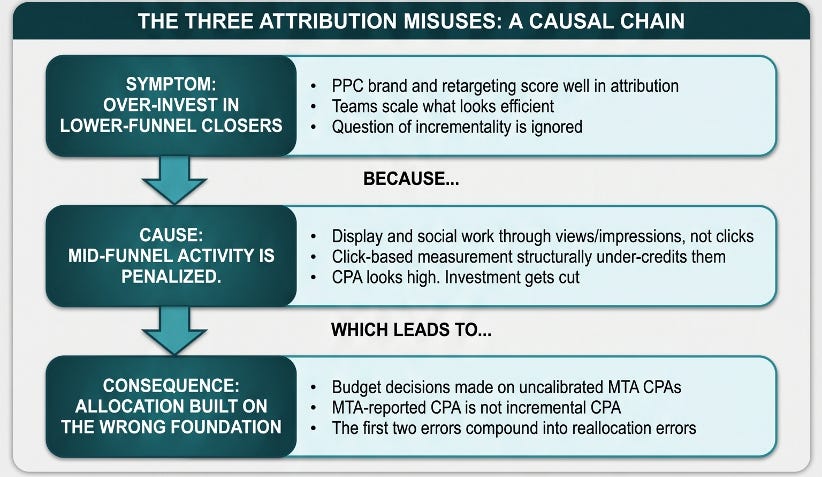
Three attribution errors are more common than any others. They are not independent. Each one feeds the next.
Over-investing in lower-funnel closers. PPC brand and retargeting score brilliantly in attribution, especially under last-click models. The CPA looks tight. The ROAS looks strong. Teams scale these channels because the numbers say they work. The question nobody asks is whether those conversions were incremental - whether the customer would have arrived at the site and converted regardless of the ad. Attribution does not answer that question. It shows who got credit. It does not show who earned it.
Under-investing in mid-funnel activity. Display, social, and consideration campaigns have higher CPA in click-based attribution because they work through view-through impressions, not direct clicks. A customer sees a social ad, does not click, but arrives at the brand site through search three days later. The search campaign gets the click and the credit. The social campaign gets nothing. Click-based attribution structurally under-credits anything that works through awareness or consideration rather than a direct response.
Making allocation decisions on uncalibrated CPAs. The first two errors create a distorted CPA picture. Lower-funnel channels look cheap. Mid-funnel channels look expensive. Teams then reallocate budget based on these MTA-reported CPAs without applying any incrementality calibration. The CPA the attribution model reports is not the incremental CPA. It is a credit-distribution CPA. Investment decisions built on uncalibrated numbers compound the first two errors into systematic misallocation.
The chain runs from symptom (over-invest in closers) to cause (mid funnel penalised by click-based measurement) to consequence (allocation built on the wrong foundation). Breaking the chain requires either moving to data-driven attribution, applying incrementality calibration to attributed CPAs, or both.

Four Decisions That Determine Whether Attribution Is Useful
Attribution is not useful or useless in the abstract. Its usefulness is determined by four configuration decisions that most teams make once and never revisit.
Lookback window. The lookback window must match the product’s consideration cycle. A high-consideration product with a 60-day purchase journey needs a lookback window that captures the full path. A 7-day window on a product with a 30-day consideration cycle misses influence that shaped the conversion. Too short and you miss real contributions. Too long and you credit noise from touchpoints that had no bearing on the decision.
Conversion events. Passing only sales events back to the platform gives it a thin signal. One event type, one learning input. Softer intent metrics - site visits, product page views, basket additions - give the platform more to learn from. They tell the AI what types of interactions eventually lead to sales, even when the sale itself has not happened yet. These signals need to be combined into a unified conversion hierarchy, not treated as equal. A basket addition is not worth the same as a sale. But it is worth more than nothing.
Attribution model type. Lead generation businesses benefit from first-touch attribution because origination matters - which channel first brought the prospect into the system. Sales and e-commerce businesses benefit from multi-touch or data-driven attribution because the full journey matters - which combination of touchpoints contributed to the conversion. There is no universal right answer. Running with platform defaults without thinking about which model fits the business is the universal wrong one.
Conversion time vs interaction time. This is the most overlooked configuration decision. Conversion time reports conversions that happened in a period, regardless of when the originating touchpoint occurred. Interaction time reports conversions attributed to touchpoints that occurred in a period, regardless of when the conversion happened. The difference matters when evaluating spend effectiveness. A lookback window that extends beyond the analysis period pulls in interactions from earlier investment, muddying the read on whether current spend is working.
These four decisions are not technical details for the analytics team to handle. They determine the signal the platform learns from. They shape targeting. They shape results. A team that gets these wrong is not measuring badly. It is targeting badly - and does not know it.
Cross-Media MTA in Practice
Cross-media MTA - Markov chain, Shapley value, Bayesian models - estimates contribution inside observed digital journeys. This is useful. It is also bounded.
The critical guardrail: MTA does not prove incrementality. It distributes credit across touchpoints in observed paths. This tells you which channels showed up in the journey. It does not tell you which channels caused the conversion. For investment decisions, MTA needs MMM and incrementality testing alongside it.
In practice, MTA is the engine for week-in, week-out performance monitoring and campaign-level reallocation. When a new product launches, MTA shows how the market is responding across platforms within days. When a campaign underperforms, MTA shows where in the journey the dropout is happening. This operational speed is its primary value.
For senior stakeholders, the positioning does not require methodology detail. What each approach adds is straightforward. Markov chain models give credit based on each channel’s contribution regardless of where in the journey it appears. Shapley value adds the relationship between channels - the halo effect of one channel on another. Bayesian models add carryover effects (how previous exposure through a channel affects future visits to the same channel) and spillover effects (how exposure through one channel affects visits through a different channel). Each layer builds confidence in the numbers without requiring the stakeholder to understand the mathematics.
The three bounded use cases for MTA are clear. Validation: how did the launch perform across platforms in recent weeks. Diagnostic: what do the customer journeys look like, where are the drop-off points, which channels appear together. Not investment allocation alone. Budget decisions that involve shifting significant spend between channels need incrementality calibration. MTA tells you the shape of the journey. It does not tell you which parts of the journey were incremental.
Attribution in a Cookieless World
The structural shift is already in motion. Cross-media MTA as traditionally built - stitching click and impression data across platforms and devices using third-party cookies - is compromised. Onsite MTA is click-only and loses further signal as cookie coverage degrades. Platform-level attribution, by contrast, stays intact within its own walls.
This creates a tension that the industry has not resolved.
When you apply causal multipliers from lift tests or MMM to convert attributed conversions into incremental sales, you have to choose which attribution foundation to apply them to. Apply them to onsite MTA and you get a cross-platform view, but it is built on click-only data with thinning coverage. Apply them to platform attribution and you get a richer view that includes impressions, but it is confined to a single platform with all the over-crediting that entails.
The cookieless environment makes this sharper. The cross-platform view loses more signal with each browser update and privacy change. The platform view stays rich but stays narrow. Neither gives you a clean answer.
This is not a solved problem, and the article will not pretend it is. It is a design choice. Each organisation needs to decide which foundation to calibrate against, knowing the blind spots of each. The honest position is that platform-level attribution becomes more operationally important as cross-media stitching degrades - not because it is more accurate, but because it retains the signal density that onsite analytics is losing.
(The series will return to this tension in M025 and M026, which address cookieless measurement and attribution directly.)
Attribution Meets Incrementality
Three layers build on each other, and each one matters.
Attribution only looks at digital touchpoints. It cannot see offline influence, word of mouth, or organic demand that was going to convert regardless of advertising. This makes it structurally incomplete by construction. It measures the digital path. The digital path is not the whole path.
Data-driven attribution gives causality to contribution. It estimates which channels contributed to the conversion and in what proportion. This is useful for understanding journey patterns. But contribution is not incrementality. A channel that contributed to a conversion is not the same as a channel that caused the conversion. DDA tells you who was there. It does not tell you whether the outcome would have been different without them.
Incrementality testing gives the closest read on true incremental effect. It measures what happens when you turn a channel on or off, increase or decrease spend, change the audience or the creative. This is the causal layer.
The practical bridge between attribution and incrementality is the ratio. When you measure incrementality at a specific point - for a specific channel at a specific spend level - you get the relationship between attributed conversions and incremental conversions. Run the exercise multiple times and you learn how stable that ratio is, or how much it varies across conditions. This gives teams a working calibration. Attribution runs the day-to-day engine. Incrementality periodically audits whether the engine is pointed in the right direction. When the ratio drifts, you recalibrate.
(The next article in this series, M014, explores incrementality as a standalone discipline - the question behind every optimisation decision.)
The Road Ahead
Attribution tells you how customers are finding you. It tells you which campaigns, which platforms, which touchpoints are present in the journey. It tells you this faster than any other measurement method. And it tells the platform’s AI where to look next.
What it does not tell you is whether those customers would have found you anyway. Whether the touchpoint that claimed credit created the conversion, or intercepted someone who was already on their way.
Attribution keeps you on the road. It does not tell you whether the road was the right one. That question requires a different instrument entirely.
If you are trying to translate these mental models into operating systems that run day to day, this is the problem KaiSignals works on.